AI Agent: Goals, Tools, Feedback, and Guardrails
Also known as: Artificial intelligence agent · LLM agent · Agentic system
Definition
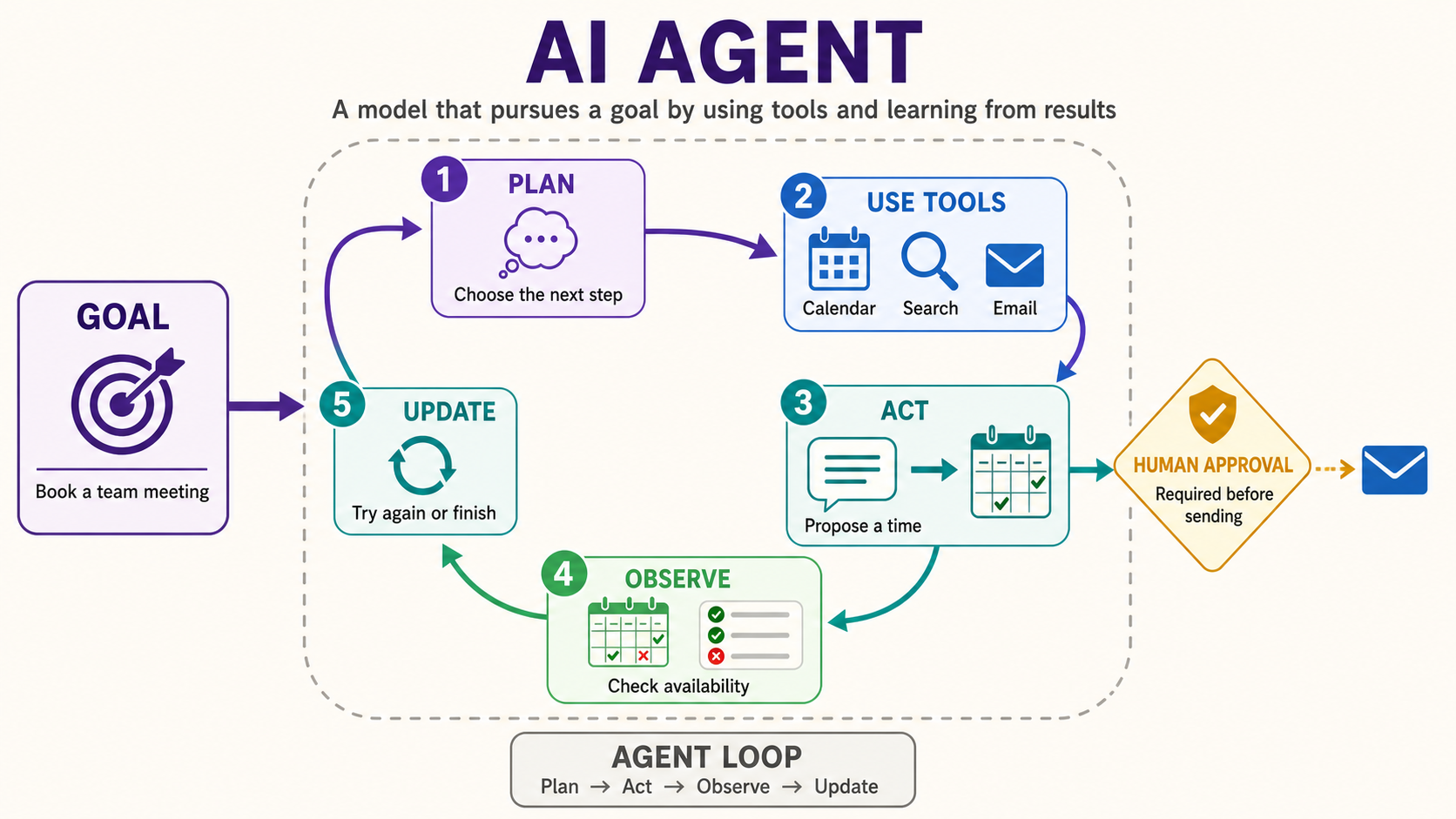
An AI agent is a system that uses a model to interpret a goal, choose actions, interact with tools or an environment, observe results, and adapt within defined limits.
Contents
An AI agent is a software system that can pursue a goal through a sequence of decisions and actions. In current language-model applications, an agent usually combines a model with instructions, tools, state, and a control loop. The model does not merely return one answer; it can decide to search, call an API, edit a file, ask for clarification, inspect the result, and continue until it reaches a stopping condition.
Simple analogy
Think of a careful assistant working inside a secured workshop. You give the assistant a goal and a set of approved tools. The assistant observes the current situation, chooses one tool, performs a step, checks what changed, and updates the plan. If a decision is risky or outside the rules, the assistant must pause for approval.
The assistant is not autonomous in an unlimited sense. Its useful autonomy comes from making bounded choices inside a designed environment. The quality of the system depends as much on tool permissions, feedback, and stop rules as on the intelligence of the underlying model.
How it works
Goal and operating instructions
The agent begins with a goal, such as resolving a support request or preparing a report. System instructions define its role, constraints, output requirements, and escalation rules. A vague goal can produce wandering behavior, so effective agents need a clear success condition and an explicit boundary around what they may change.
Model-driven decisions
At each step, the model receives a representation of the current state: the goal, relevant conversation, previous tool results, and available actions. It chooses a next action or decides that the task is complete. Some systems expose an internal plan; others decide incrementally without preserving a fixed plan. The important feature is that the path can change in response to observations.
This distinguishes an agent from a fixed workflow. A workflow follows control logic predetermined in code, even if models fill individual steps. An agent lets a model choose among possible steps at runtime. Real applications often combine both: deterministic code handles known rules, while an agent handles the parts that require interpretation or adaptation.
Tools and environment
Tools connect the model to external capabilities. They may search documents, query a database, run code, operate a browser, send a message, or update a business system. A tool definition specifies its name, purpose, input schema, and expected result. The host application executes the tool; the language model itself does not directly reach arbitrary systems.
Tool design is a security boundary. An agent given a narrow “create draft” tool has less power than one given unrestricted database access. High-impact operations should use scoped credentials, validation, idempotency, audit logs, and human approval where appropriate. Tool results must also be treated as potentially untrusted input, especially when they include web pages, messages, or documents that could contain malicious instructions.
Observation and feedback loop
After an action, the environment returns an observation. The agent evaluates whether the step worked, whether new information changes the plan, and what to do next. Research patterns such as ReAct interleave reasoning with actions and observations so a system can gather information instead of relying only on an initial response.
The loop needs termination conditions. It may stop when a verifier confirms success, when the model produces a final answer, when the user cancels, or when a limit on time, cost, or steps is reached. Without limits, an agent can repeat failed actions, spend unexpectedly, or compound an early mistake.
State, memory, and evaluation
Short-term state records the current task and recent results. Longer-term memory may store preferences, past outcomes, or retrieved knowledge, but it should not be confused with perfect human memory. Stored information needs provenance, retention rules, access control, and a way to correct or delete it.
Agent evaluation should measure task completion, correctness, unsafe actions, unnecessary steps, latency, cost, and behavior on adversarial inputs. A convincing demonstration is not enough. Production evaluation needs repeatable tasks, captured traces, failure categories, and regression tests for tool and policy changes.
Why it matters
A conventional model call is well suited to a bounded transformation: summarize this document, classify this message, or draft this paragraph. An agent becomes useful when the path cannot be fully known in advance and the system must gather information, choose among tools, or recover from intermediate failures.
Agents can turn models into interfaces for complex software, but they also move AI from generating content to causing effects. That raises the stakes. A wrong paragraph can be reviewed; a wrong database update or message may be difficult to reverse. The more autonomy and tool access an agent receives, the stronger its verification, permission, monitoring, and recovery mechanisms must be.
Practical use cases
- Research: Search several sources, extract evidence, compare claims, and return a cited synthesis.
- Software work: Inspect a codebase, edit files, run tests, and revise a change after failures.
- Support operations: Gather account context, consult policy, draft a resolution, and escalate exceptions.
- Data analysis: Select approved datasets, run calculations, check outputs, and create a report.
- Back-office coordination: Prepare drafts or recommendations across systems while reserving consequential actions for human approval.
A deterministic workflow is often better when the sequence is stable, the rules are known, and every outcome must be predictable. Adding an agent where ordinary code is sufficient can increase cost and failure modes without adding value.
Common misconceptions
“An AI agent is just a chatbot.” A chatbot may only produce conversational responses. An agent has a loop that can choose actions, use tools, observe results, and continue toward a goal. A chat interface can host an agent, but the interface does not define it.
“Agents must run without human involvement.” Many useful agents are supervised. They can prepare work, request approval for sensitive steps, or hand off when confidence is low. Human checkpoints are a design feature, not a failure of autonomy.
“More tools make an agent more capable.” Extra tools also make selection harder and expand the attack surface. A small set of clear, scoped tools is often more reliable than a large set of overlapping capabilities.
“Reasoning guarantees correct action.” A model can produce a plausible plan and still misunderstand the task, misuse a tool, or accept a malicious observation. External validation and constrained execution remain necessary.
“Multi-agent systems are automatically better.” Multiple agents can separate roles or parallelize work, but they add coordination, latency, cost, and new failure modes. Start with the simplest architecture that meets the task and evaluation requirements.
Frequently asked questions
What is the difference between an AI agent and an AI workflow?
A workflow follows a path largely defined in code. An agent lets a model choose the next action based on the current state and observations. Many reliable systems embed a bounded agent inside a deterministic workflow.
Does an AI agent need long-term memory?
No. An agent needs enough state to continue its current task, but persistent memory is optional. When used, it requires provenance, permissions, retention limits, and correction or deletion mechanisms.
How should high-risk agent actions be controlled?
Use narrowly scoped tools and credentials, validate arguments, preview effects, require approval for consequential operations, log actions, make writes idempotent when possible, and provide a recovery or rollback path.
When is a fixed workflow better than an agent?
Use a fixed workflow when the steps and rules are stable, predictable execution matters more than adaptation, and ordinary code can handle the decision logic. Agents are most useful when the path must change based on uncertain observations.