
Transformer: The Architecture Behind Modern AI
Also known as: Transformer model · Transformer architecture
Definition
A Transformer is a neural-network architecture that uses attention to build context-aware representations of tokens, allowing many sequence positions to be processed in parallel.
Contents
A Transformer is a neural-network architecture for processing structured sequences. Introduced in the 2017 paper Attention Is All You Need, it replaced the recurrence used by many earlier language systems with attention-based layers. The original model was designed for machine translation, but Transformer variants now underpin language models, vision systems, speech models, and multimodal systems.
Simple analogy
Imagine a group editing a sentence together. Instead of reading one word at a time and passing a single note down the line, every editor can look at every word at once. Each editor asks which other words matter for interpreting the word in front of them. In the sentence “The animal did not cross the street because it was tired,” the word “it” should pay more attention to “animal” than to “street.”
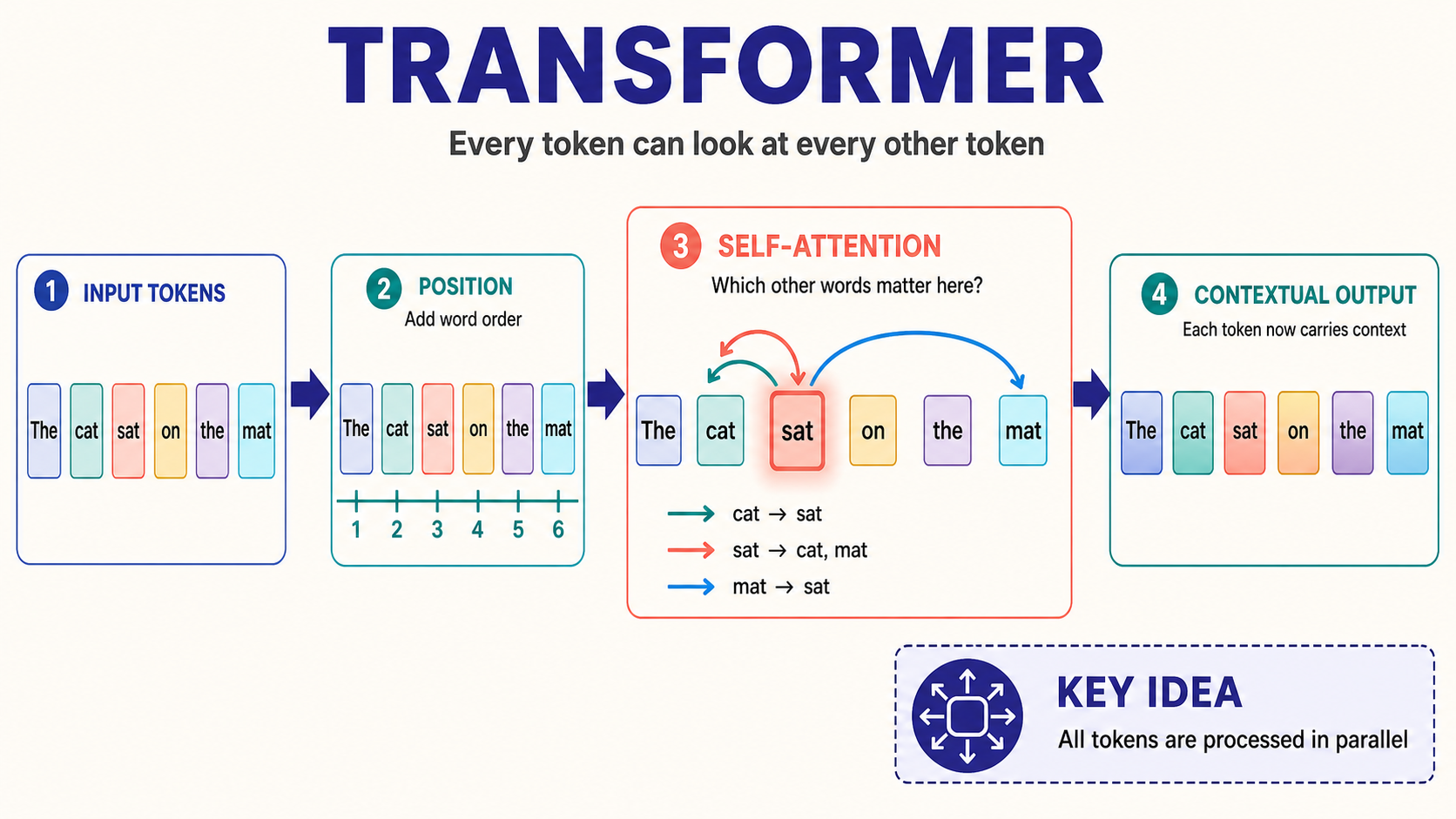
A Transformer performs a mathematical version of that comparison. It gives each token a representation, measures how strongly it should attend to other tokens, and blends relevant information into a new contextual representation. Several attention heads can examine different relationships in parallel, much like editors focusing on grammar, reference, order, or topic.
How it works
Tokens and position
The input is first divided into tokens. A token may be a word fragment, an image patch, an audio segment, or another discrete unit. Each token becomes a vector called an embedding. Because attention alone does not inherently know sequence order, the model also receives positional information. The original Transformer used sinusoidal positional encodings, while later architectures often use learned or relative position methods.
Queries, keys, and values
Self-attention derives three vectors from every token: a query, a key, and a value. A token's query is compared with the keys of tokens it may attend to. The resulting scores are scaled and normalized into weights. Those weights determine how much of each value vector contributes to the token's next representation.
This operation is called self-attention because the queries, keys, and values come from the same sequence. Cross-attention is a related operation in which queries come from one sequence and keys and values come from another. The encoder-decoder Transformer used cross-attention so the decoder could consult the encoded source sentence while producing a translation.
Multiple heads and repeated layers
Multi-head attention runs several attention operations with different learned projections. The heads can represent different patterns, although an individual head does not always correspond to a clean human-readable concept. Their outputs are combined and passed through a feed-forward network applied independently to each position. Residual connections and normalization help information and gradients move through the stack.
A complete Transformer repeats these blocks many times. Encoder-only architectures, such as the original BERT design, build bidirectional representations useful for understanding tasks. Decoder-only architectures generate the next token while masking future positions; this is the common shape of autoregressive language models. Encoder-decoder architectures remain useful when an input sequence is transformed into a separate output sequence.
Training and inference
During training, the model adjusts its parameters to reduce an objective such as next-token prediction, masked-token prediction, or sequence-to-sequence loss. Attention does not retrieve facts from a database by itself; any patterns learned during training are encoded indirectly in the model's parameters. During inference, the trained model applies those parameters to new input. An autoregressive decoder generates one token at a time even though computations within each individual step can be highly parallelized.
Why it matters
Removing recurrence made training more parallelizable across sequence positions than classic recurrent neural networks. Attention also creates a relatively direct route between distant tokens, which helps represent long-range dependencies. These properties made it practical to train much larger sequence models on modern accelerators.
The architecture is also flexible. If an input can be represented as tokens, Transformer-like layers can often process it. Vision Transformers treat an image as a sequence of patches. Multimodal systems can combine text, image, audio, or video representations. This does not mean one architecture is optimal for every task, but it explains why Transformers became a reusable foundation rather than a language-only technique.
The main cost is that standard self-attention compares every token with every other token. Its attention matrix therefore grows quadratically with sequence length. Longer contexts require more memory and computation, motivating sparse attention, sliding windows, compressed memory, and optimized attention kernels.
Practical use cases
- Text generation: Decoder-only Transformers predict successive tokens for writing, coding, summarization, and dialogue.
- Search and classification: Encoder representations can support semantic search, intent detection, moderation, and document classification.
- Translation and transcription: Encoder-decoder models map one sequence into another while consulting the full encoded input.
- Vision: Image patches can be processed as tokens for classification, detection, segmentation, and generation.
- Multimodal systems: Specialized encoders and shared Transformer blocks can connect language with images, audio, video, or actions.
Choosing a Transformer does not remove the need for good data, a suitable objective, evaluation, or safety controls. Architecture determines how information is processed; it does not guarantee accuracy or trustworthy behavior.
Common misconceptions
“Attention shows exactly why the model made a decision.” Attention weights expose part of a computation, but they are not a complete causal explanation of a model's output. Many layers, nonlinear transformations, and learned parameters contribute.
“Transformers process generation fully in parallel.” Training can evaluate many known target positions together, but ordinary autoregressive inference still produces tokens sequentially because each new token depends on previous output.
“A larger context window gives perfect memory.” A model may accept more tokens without using every detail reliably. Position effects, retrieval quality, attention allocation, and task difficulty still matter.
“Every modern AI model is a Transformer.” Transformers are widespread, but convolutional networks, state-space models, diffusion components, graph networks, and hybrid designs remain useful. The architecture is dominant in many areas, not universal.
Frequently asked questions
What problem did the Transformer originally solve?
The original 2017 Transformer was introduced for sequence transduction, especially machine translation. Its attention-based encoder-decoder processed relationships across a sentence without recurrent or convolutional sequence layers.
Is self-attention the same as a database search?
No. Self-attention mixes information among tokens already present in the model's current input. Database or document retrieval is a separate operation that first brings external information into that input.
Why are positional encodings needed?
Without positional information, basic self-attention does not distinguish token order. Positional encodings or relative position mechanisms let the model represent whether one token comes before, after, or near another.
What limits a Transformer's context length?
Limits come from the model's trained positional scheme, serving configuration, memory, and computation. Standard attention's quadratic growth is an important cost, but maximum accepted length and effective use of that length are separate questions.