
Large Language Models (LLMs): How They Generate Text
Also known as: LLM · Large-scale language model
Definition
A large language model is a neural network trained on extensive language data to estimate patterns in token sequences, enabling it to generate or represent text for many downstream tasks.
Contents
A large language model, commonly shortened to LLM, is a language model with enough learned parameters, training data, and computation to acquire broadly reusable patterns from text. Most prominent generative LLMs use the Transformer architecture and produce text by repeatedly estimating a distribution over the next token. However, the term also covers large encoder models built to represent text rather than generate it one token at a time. “Large” has no permanent numeric threshold; it is a relative description shaped by the era and comparison group.
Simple analogy
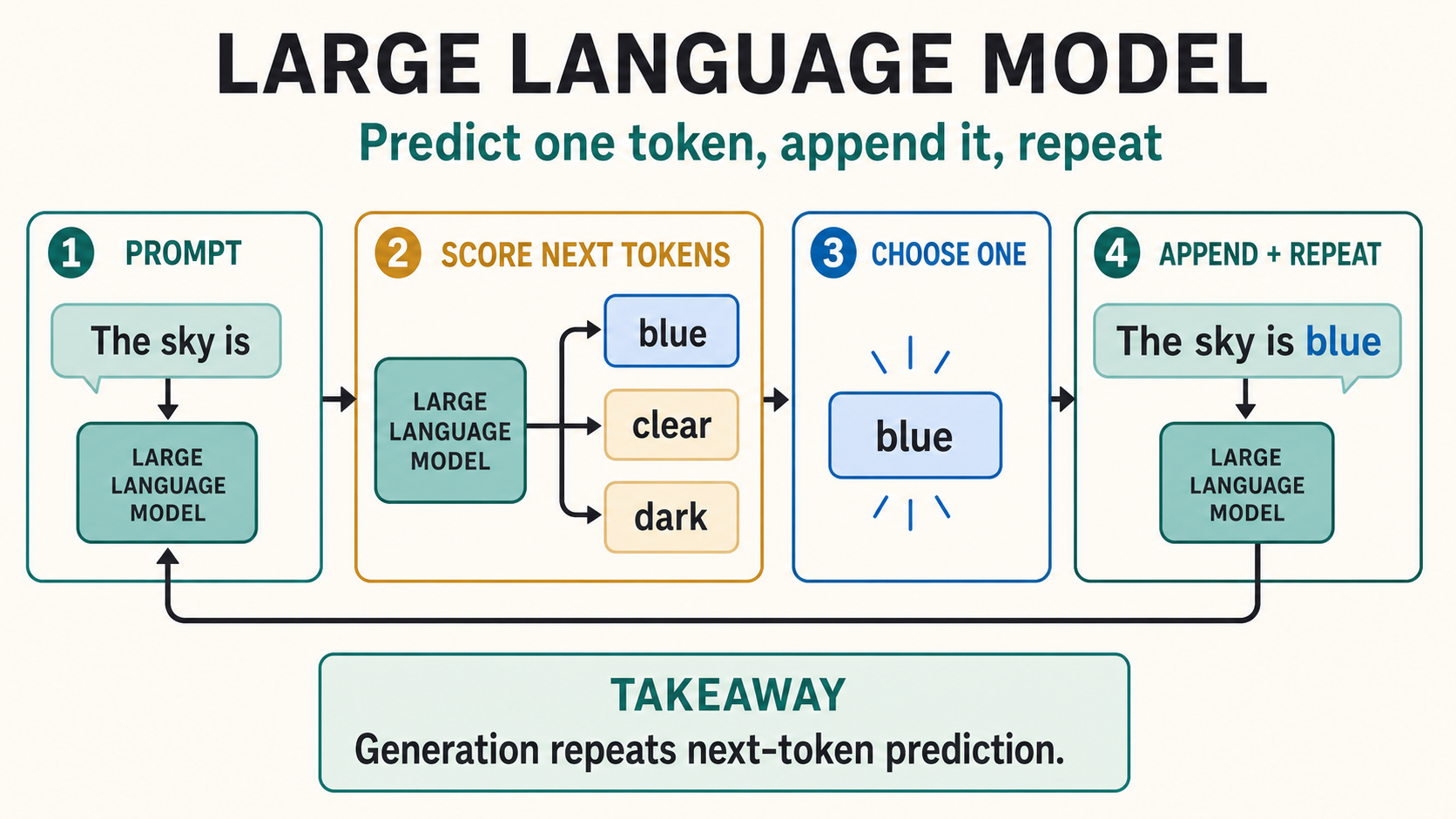
Imagine an extremely practiced sentence-completion system. It has studied many examples of how text tends to continue, but it does not retrieve one memorized sentence for every response. Given “The sky is,” it evaluates possible next pieces such as “blue,” “clear,” or “dark” in light of the preceding context. After one token is selected, that token becomes part of the context and the system repeats the process.
This analogy explains generation, not the whole model. During training, an LLM adjusts a large collection of numeric parameters so that useful patterns are distributed across the network. During use, those parameters transform the current token sequence into contextual representations and output scores. The model is more than a phrase table, yet its output is still a statistical computation rather than a guarantee of truth.
How it works
Convert text into tokens
A tokenizer first maps text to discrete token IDs. Each ID selects an embedding vector, and positional information distinguishes where the token appears in the sequence. Tokenization matters because the model's context window, training examples, and generated output are all represented in tokens rather than human word counts.
Learn from a training objective
Autoregressive language models are commonly trained to predict the next token from earlier tokens. The training corpus provides known continuations, and optimization adjusts model parameters to reduce prediction error across many examples. Encoder models such as the original BERT instead used a masked-token objective and bidirectional context to learn representations useful for understanding tasks. These objectives are related forms of self-supervised learning: supervision is constructed from the data itself rather than requiring a human label for every sequence.
Training does not store a clean database of statements. It compresses many regularities into parameter values. Some sequences can be memorized, especially when repeated, but useful behavior also depends on generalizing patterns to new combinations. Model size, data amount, data quality, optimization, and compute allocation interact; parameter count alone does not determine capability. Research on compute-optimal training showed that scaling data and model size together can be more effective than increasing parameters while holding training data nearly fixed.
Transform context with attention
In a Transformer LLM, attention lets each token representation combine information from other permitted positions. Repeated attention and feed-forward layers build context-sensitive representations. In an autoregressive decoder, a causal mask prevents a position from seeing future tokens during training. At inference time, the model processes the available context and emits scores, called logits, for vocabulary tokens that could come next.
A decoding method turns those scores into a choice. Greedy decoding selects the highest-scoring token, while sampling can introduce controlled variation. Parameters such as temperature change the selection distribution; they do not add new knowledge or verify facts. The selected token is appended, and the cycle continues until a stopping condition, length limit, or special end token is reached.
Adapt the pretrained model
Pretraining creates a general model, but deployed assistants often add further stages. Fine-tuning can teach examples of desired tasks or response formats. Preference-based training can push behavior toward human judgments. System instructions, retrieval, tool use, and safety filters can shape a particular product without changing the basic definition of an LLM. These layers should not be confused with the underlying model's training objective.
Why it matters
A single pretrained LLM can support many language tasks through instructions, demonstrations, or lightweight adaptation. GPT-3 research showed that increasing model scale improved zero-shot and few-shot behavior on a range of evaluated tasks, although it also documented failures and methodological concerns. BERT showed a different reuse pattern: one pretrained encoder could be fine-tuned with a small task-specific output layer for multiple language-understanding benchmarks.
This reuse changes how language software is built. Instead of training a separate architecture from scratch for every task, developers can start with a general model and add context, examples, retrieval, or task-specific training. The same flexibility also makes evaluation harder: fluent output can hide factual errors, unstable reasoning, bias, or sensitivity to phrasing.
LLMs require substantial training computation and can require significant memory and inference resources. Their context windows are finite, and accepting more tokens does not guarantee that every detail will be used reliably. Training data can contain private, copyrighted, low-quality, or harmful material, creating governance and risk questions beyond model architecture.
Practical use cases
- Writing and transformation: Drafting, rewriting, translating, summarizing, and changing tone or format.
- Question answering: Producing answers from model parameters, supplied context, or retrieved documents, with accuracy depending on the evidence and evaluation process.
- Programming assistance: Generating, explaining, testing, and refactoring code while still requiring review and execution-based verification.
- Classification and extraction: Mapping unstructured text to categories, fields, entities, or structured outputs.
- Search and retrieval interfaces: Rewriting queries, synthesizing retrieved evidence, or producing embeddings through a suitable model.
- Agent components: Interpreting goals, selecting tools, and generating intermediate actions inside a controlled system.
High-stakes uses need more than a capable model. They require reliable sources, domain-specific evaluation, privacy controls, monitoring, and human or automated checks appropriate to the consequences of an error.
Common misconceptions
“An LLM looks up every answer in its training data.” Parameters encode learned patterns, not a browsable citation database. A model can reproduce memorized material, generalize, or fabricate a plausible continuation; its text alone does not reveal which occurred.
“Next-token prediction is just autocomplete, so complex behavior is impossible.” The training objective is simple to state, but a large network can learn rich internal representations needed to predict across many contexts. Complex behavior can emerge from that process without making every output correct or intentional.
“Larger always means better.” Capability depends on data, architecture, optimization, compute, evaluation, and deployment. A smaller model can outperform a larger but poorly trained model on a particular task.
“Fluent language proves understanding or truth.” Fluency reflects learned language regularities. A response can be grammatical, confident, and wrong, so factual claims need evidence and verification.
Frequently asked questions
Are all large language models generative chatbots?
No. Some large language models are encoders designed to produce contextual representations. A chatbot is a product that may combine a generative LLM with instructions, retrieval, tools, safety systems, and a conversation interface.
What does a parameter do in an LLM?
A parameter is a learned numeric value used in the network's transformations. Training adjusts many parameters together; an individual parameter usually does not correspond to one readable fact or rule.
Why can the same prompt produce different answers?
Sampling can select among several plausible next tokens, and small context changes can alter later probabilities. Deterministic decoding reduces variation but does not guarantee factual correctness.
Does a longer context window give an LLM permanent memory?
No. Context is temporary input for a request or session unless an external system stores it. A larger window also does not ensure that the model will use every included detail reliably.
Related concepts
Models & Architecture
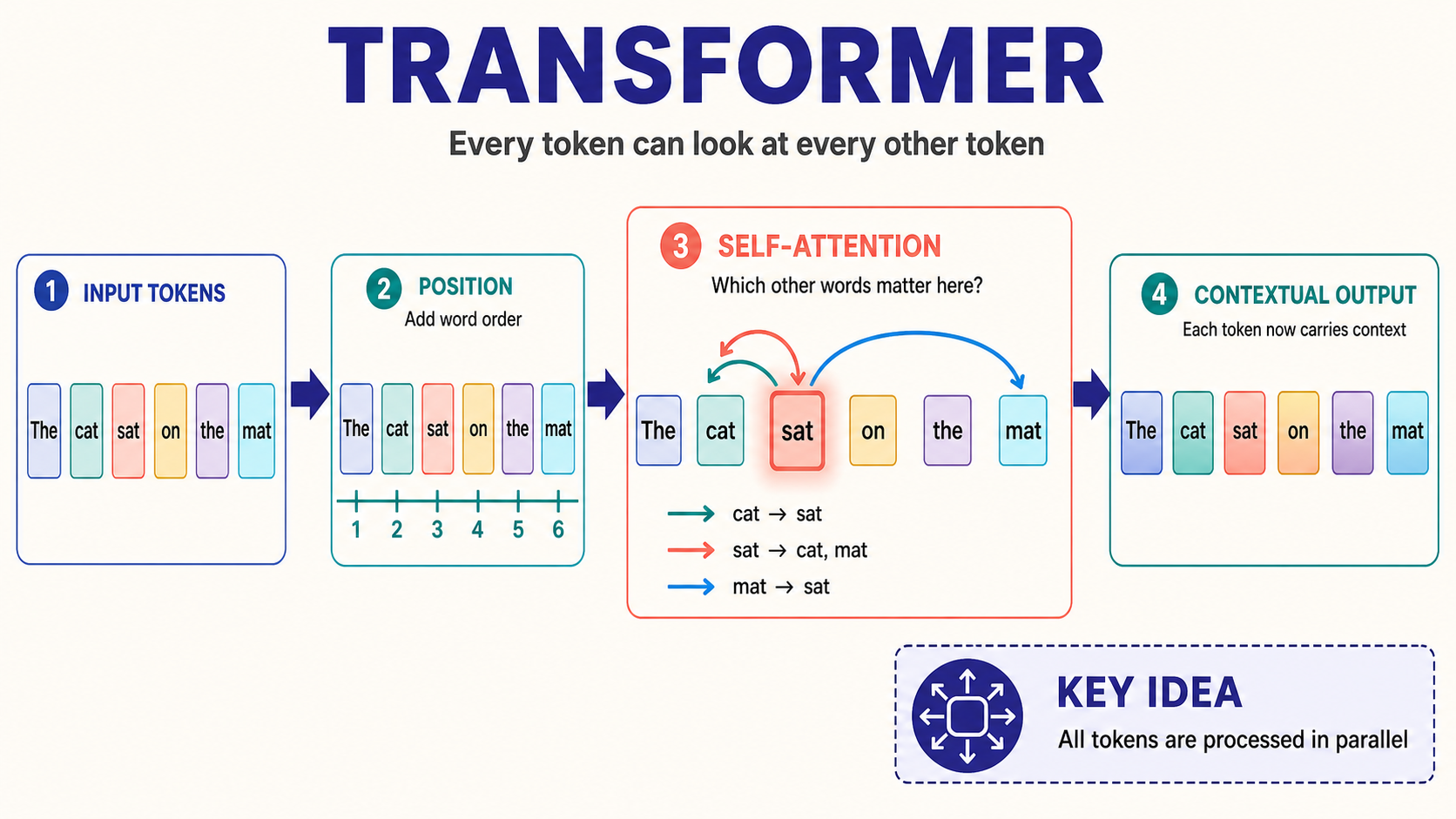
Transformer: The Architecture Behind Modern AI
A Transformer is a neural-network architecture that uses attention to build context-aware representations of tokens, allowing many sequence positions to be processed in parallel.
#neural networks#attention#model architectureRead entry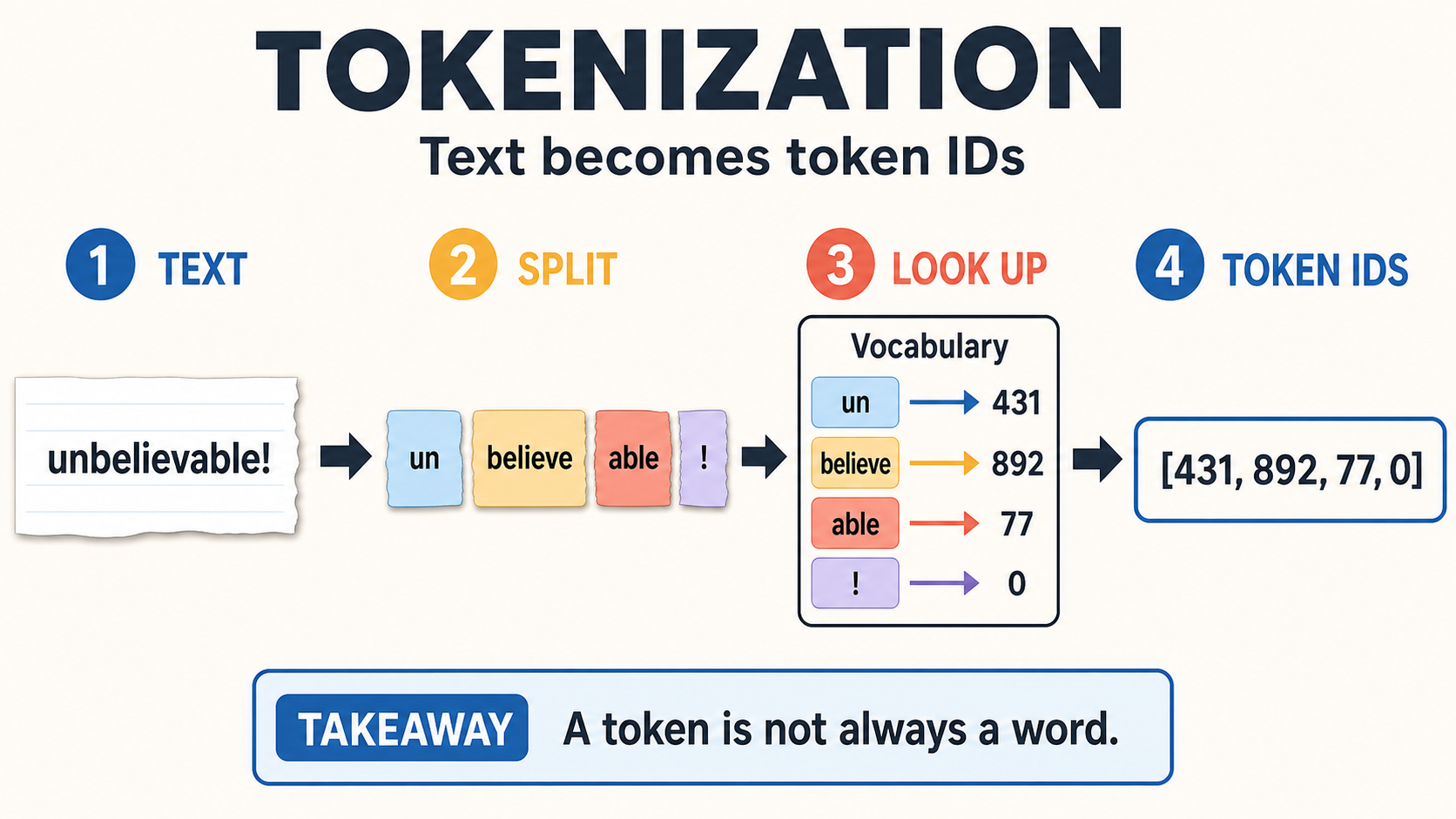
Foundations
Tokenization: How AI Models Break Text into Tokens
Tokenization is the process of converting text or another input into a sequence of discrete units called tokens, then mapping those tokens to numeric identifiers that a model can process.
#tokens#NLP#text processingRead entry