
Vector Embeddings: How AI Represents Meaning as Numbers
Also known as: Embedding · Dense vector · Vector representation
Definition
A vector embedding is a learned numeric representation of an item in which distance or direction can encode useful relationships, such as semantic similarity between pieces of text.
Contents
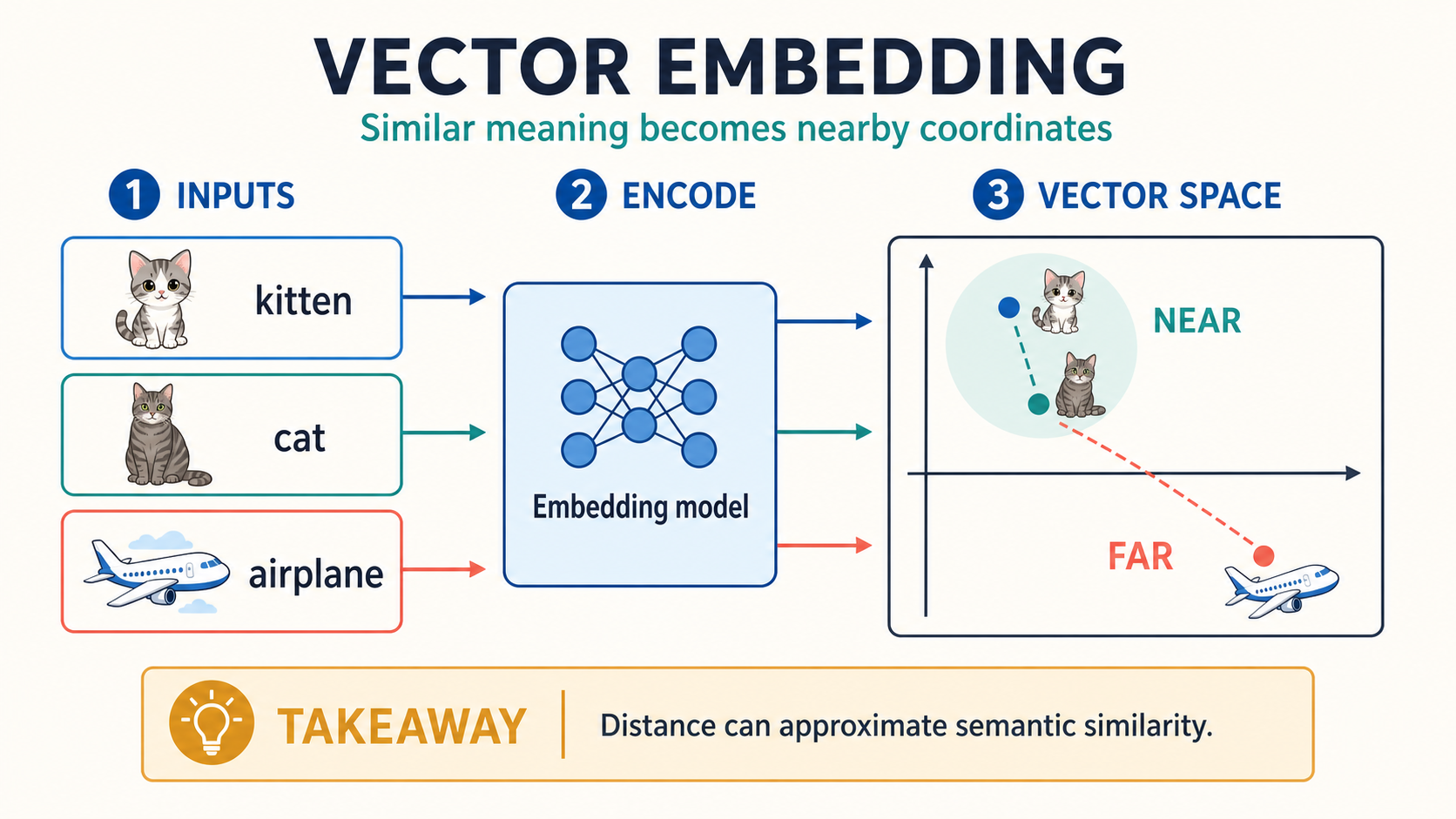
A vector embedding converts an item into an ordered list of numbers. The item might be a word, sentence, document, image, user, product, or another object. An embedding model is trained so that geometry in the resulting vector space captures relationships useful for its objective. For text embeddings, inputs with similar meaning are often designed to have nearby vectors, allowing a system to compare meaning with a mathematical similarity function.
Simple analogy
Imagine placing books on a huge map. Nearby positions are reserved for books with similar content: a guide to caring for kittens sits near a guide to cats, while an aircraft maintenance manual appears farther away. The map does not need a named aisle for every possible topic. Instead, many hidden directions combine to determine each location.
An embedding works like coordinates on that map, except a production vector may have hundreds or thousands of dimensions rather than the two shown on paper. The two-dimensional picture is only a teaching projection. Real dimensions usually do not each have a simple label such as “animal” or “technology,” and closeness reflects the model's training objective rather than perfect human judgment.
How it works
Encode an input
An embedding model accepts an input and produces a fixed-length vector. A text embedding pipeline first tokenizes the text, processes it with a neural network, and combines contextual information into one vector for the entire input or into vectors for individual tokens. The same model and preprocessing must be used for items that will be compared directly.
Early neural word-embedding work demonstrated that continuous vectors learned from large text collections could capture syntactic and semantic similarities between words. Later systems extended the idea to sentences and passages. Sentence-BERT, for example, used siamese and triplet network structures to produce sentence embeddings intended for efficient comparison with cosine similarity. Dense Passage Retrieval trained separate encoders for questions and passages so relevant pairs could receive compatible dense representations.
Compare vectors
Once two items are vectors of the same dimension, a system can compute a similarity or distance score. Cosine similarity compares their direction, dot product combines direction and magnitude, and Euclidean distance measures straight-line separation. The right choice depends on how the model was trained and whether vectors are normalized. Scores from different embedding models are generally not interchangeable.
A similarity score is relative, not a universal percentage of shared meaning. Applications usually rank candidates and choose a threshold based on validation data. A score that works for duplicate detection may be inappropriate for broad topical search.
Build an index and retrieve neighbors
For a small collection, an application can compare a query vector with every stored vector. Large collections usually use a vector index and an approximate nearest-neighbor algorithm to find close candidates efficiently. Approximation trades a small amount of recall for speed and memory efficiency. Metadata filters can narrow the search by language, date, access permission, product category, or other structured fields.
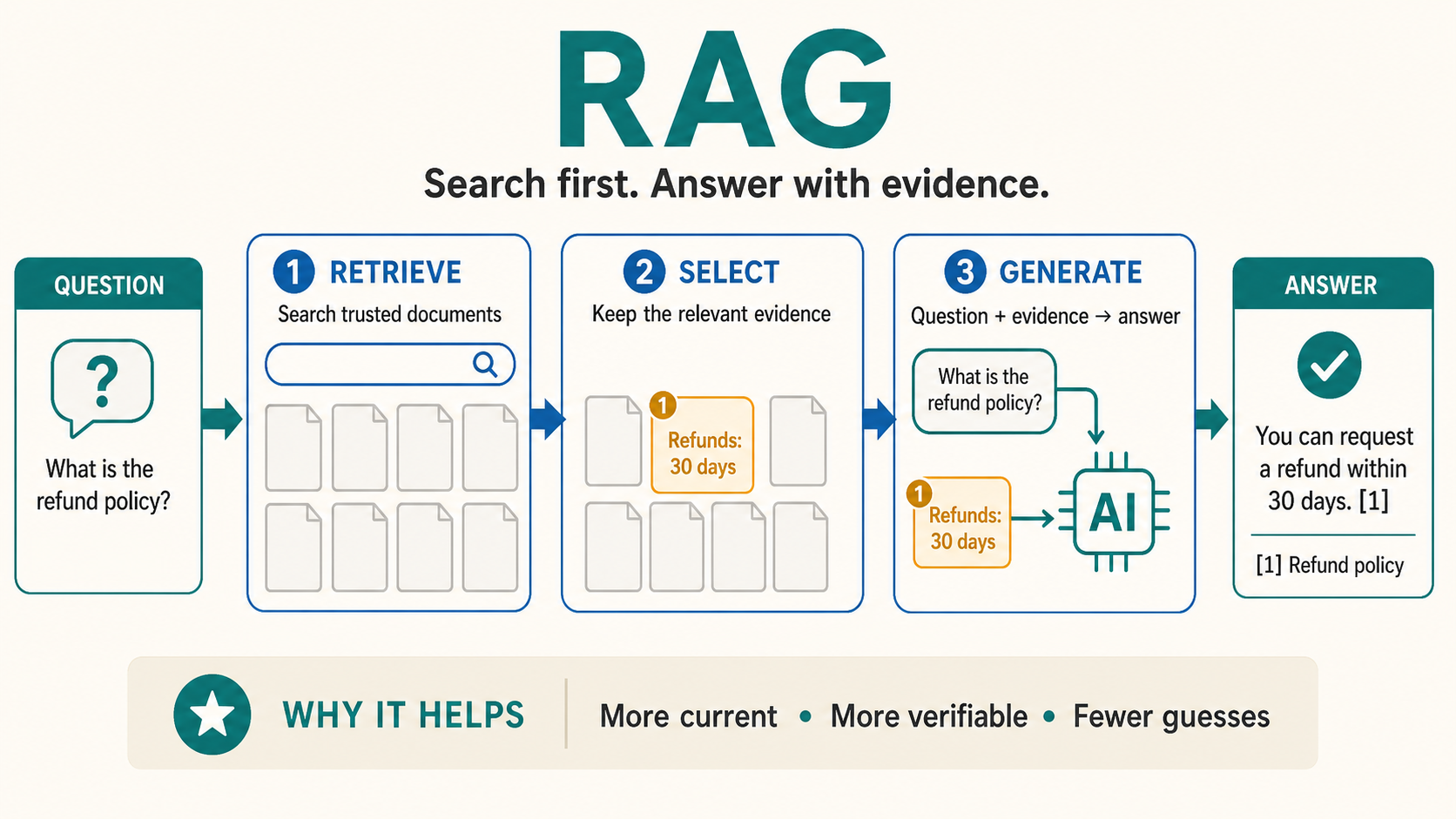
In retrieval-augmented generation, documents are divided into chunks and embedded in advance. A user query is embedded with a compatible model, nearby chunks are retrieved, and selected text is supplied to a language model. Embeddings perform the candidate search; they do not by themselves write the final answer or prove that a retrieved passage is correct.
Train the geometry
Embedding behavior comes from a training objective and examples of related or unrelated items. Contrastive training can pull positive pairs closer and push negative pairs apart. The definition of a positive pair matters: question-and-answer pairs create a different useful geometry from paraphrase pairs or image-caption pairs. This is why an embedding model should be evaluated on the application's real retrieval or classification task.
Why it matters
Embeddings turn unstructured content into a form that standard numerical systems can search and organize. Keyword search depends heavily on shared terms; vector search can retrieve text that expresses a related idea with different wording. Dense retrieval research showed that learned question and passage representations could support effective open-domain question answering, while sentence embeddings made large-scale semantic comparison more practical than evaluating every sentence pair jointly with a cross-encoder.
The representation is compact enough to precompute for a collection, then reuse for many queries. This separation makes embeddings useful as infrastructure: one vector index can support semantic search, recommendations, clustering, duplicate detection, and candidate generation. A more expensive model can then rerank or analyze the smaller candidate set.
Embeddings also have limitations. They compress information and inevitably discard details. Similarity can reflect correlations or biases in training data. Long documents may need chunking, which can separate evidence from its context. Approximate indexes can miss neighbors, and a poor threshold can return irrelevant results or hide useful ones. Sensitive content remains sensitive after vectorization; access controls and retention policies still apply.
Practical use cases
- Semantic search: Retrieve passages that express an idea even when they do not repeat the query's exact words.
- Retrieval-augmented generation: Select candidate context for an LLM before it produces an answer.
- Clustering and topic exploration: Group a collection by learned similarity, then inspect and label the groups.
- Recommendations: Find items or content near a user's interests, often alongside behavioral and business signals.
- Duplicate and paraphrase detection: Identify near-equivalent text for moderation, cleanup, or support workflows.
- Classification: Compare an input with label descriptions or use embeddings as features for a supervised classifier.
A robust system evaluates retrieval separately from the downstream model. Useful measures may include recall at a chosen candidate count, ranking quality, latency, index size, and performance across languages or user groups.
Common misconceptions
“Each vector coordinate has a clear human meaning.” Learned dimensions are distributed features. Individual coordinates usually cannot be named reliably, even when the overall geometry supports useful comparisons.
“Nearby vectors mean two items are factually equivalent.” Proximity reflects patterns learned for a task. Two passages can discuss the same topic while disagreeing, or sound similar while differing in a critical number or condition.
“A vector database creates the embeddings.” An embedding model creates vectors. A vector database or index stores them and performs efficient similarity search, filtering, and updates.
“Embeddings from different models can be mixed.” Different models define different coordinate systems and dimensions. Old documents normally need to be re-embedded when a system switches to an incompatible embedding model.
Frequently asked questions
How many dimensions should an embedding have?
There is no universal best number. Dimension is part of the trained model design and affects storage, speed, and representational capacity. Use the model's supported output and evaluate it on the target task.
What is cosine similarity?
Cosine similarity compares the angle between two vectors. Vectors pointing in similar directions receive a higher score, largely independent of their raw magnitudes.
Why are documents split into chunks before embedding?
A single vector for a long document can blur several topics. Smaller chunks make retrieval more specific, but chunks must remain large enough to preserve the context needed to understand the evidence.
Can an embedding be converted back into the original text?
Not reliably. An embedding is a compressed representation optimized for relationships, not a lossless text encoding. The original content should be stored separately when it must be displayed or audited.
Related concepts
Knowledge & Tuning
Retrieval-Augmented Generation (RAG) Explained
Retrieval-Augmented Generation is a method that retrieves relevant external information for a query and supplies it to a generative model as context before the model produces an answer.
#RAG#retrieval#LLM applicationsRead entry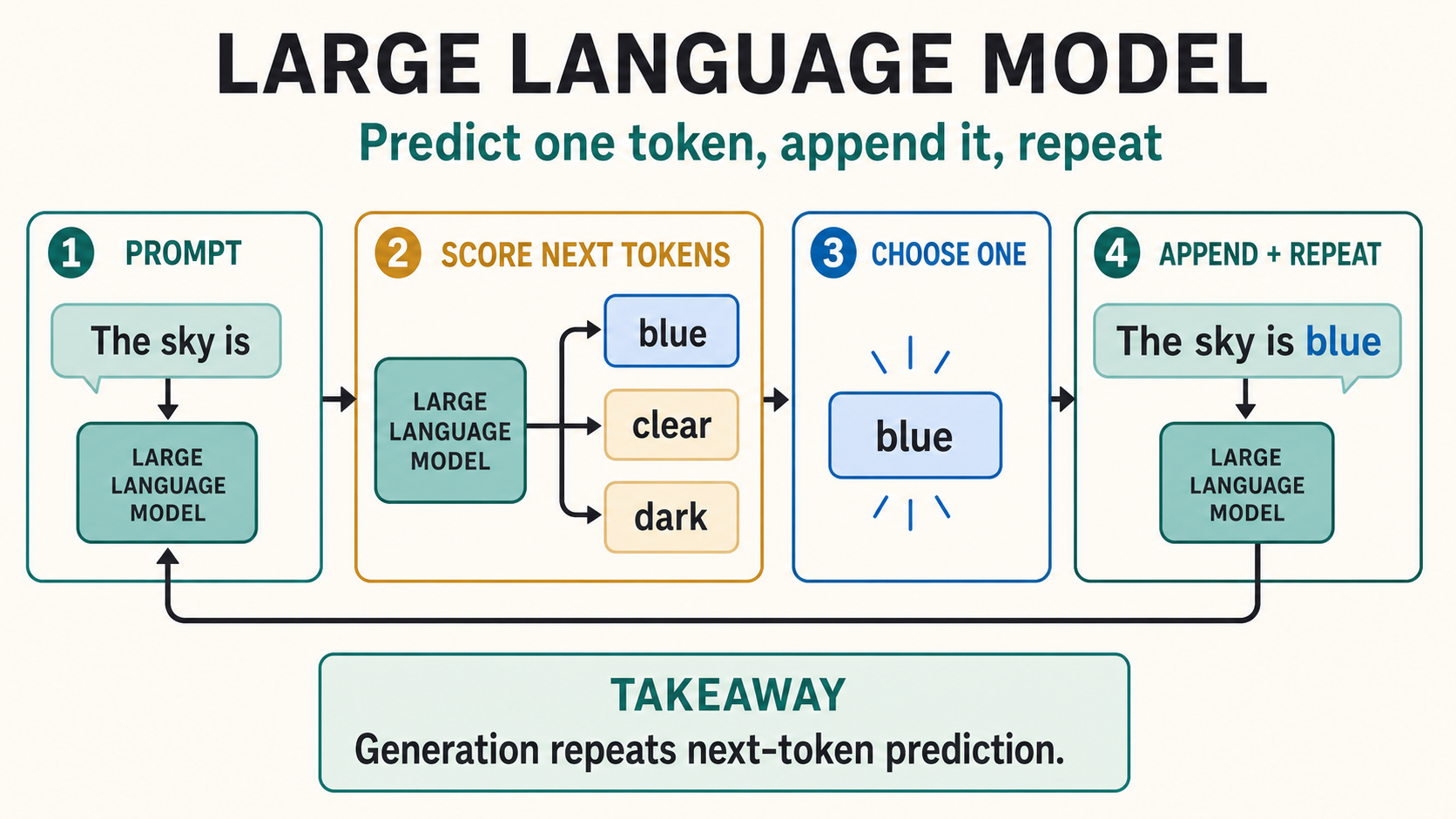
Models & Architecture
Large Language Models (LLMs): How They Generate Text
A large language model is a neural network trained on extensive language data to estimate patterns in token sequences, enabling it to generate or represent text for many downstream tasks.
#language models#generative AI#TransformersRead entry