
Attention Mechanism: How AI Focuses on Context
Also known as: Attention · Self-Attention
Definition
An attention mechanism lets a neural network build a representation by assigning different weights to available pieces of context, so the most relevant information contributes more strongly to the result.
Contents
Attention is a way for a neural network to decide which parts of its available context matter most for the item it is currently processing. Instead of compressing an entire sentence into one fixed summary, the model can construct a fresh, context-aware representation for every token.
Simple analogy
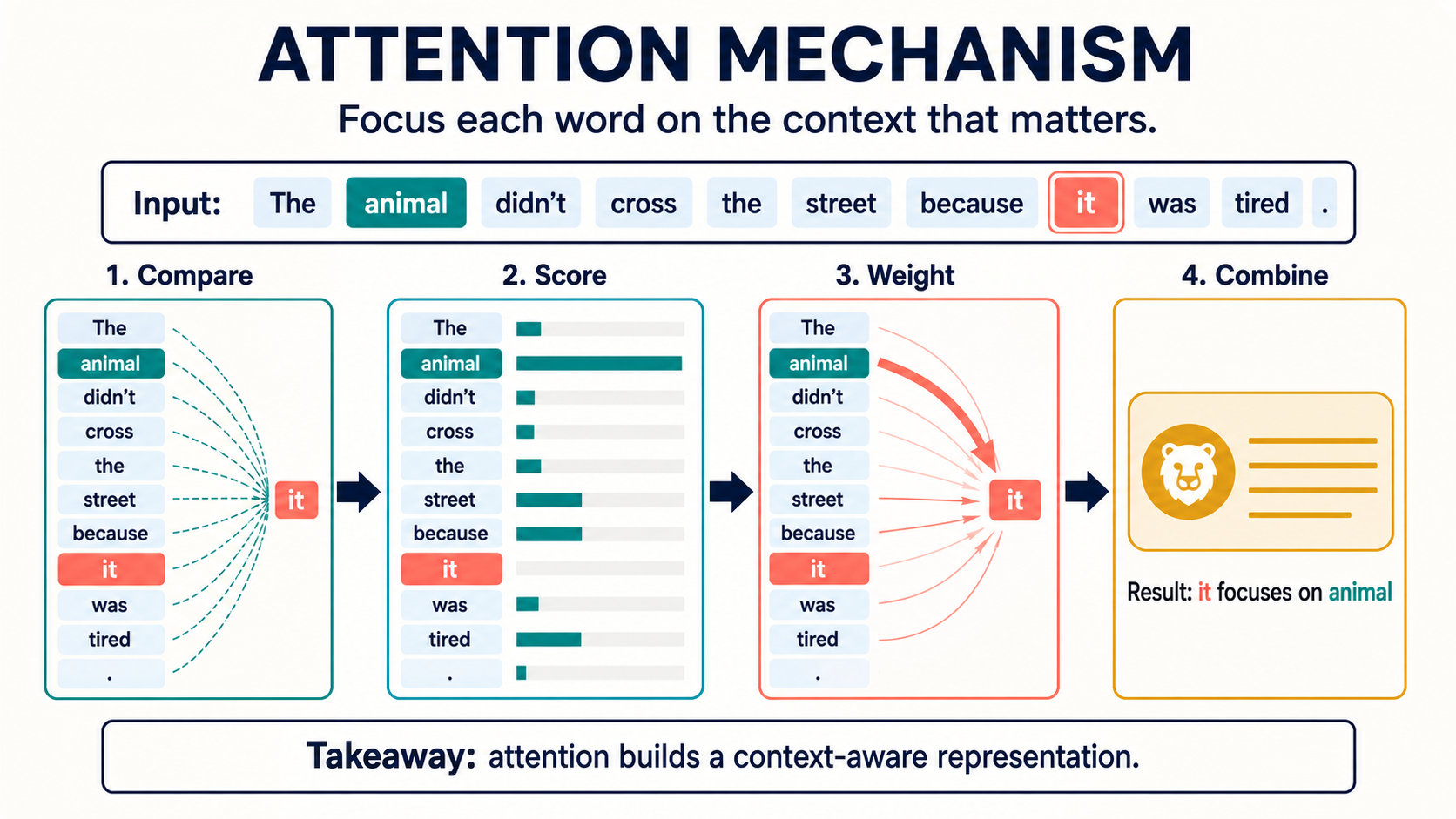
Imagine reading the sentence “The animal did not cross the street because it was tired.” When you interpret “it,” you do not give every earlier word equal importance. You connect “it” more strongly with “animal” than with “street,” because that relationship makes the sentence coherent.
Attention performs a numerical version of this selective lookup. It compares the current token with the available context, assigns relevance weights, and blends information using those weights. The mechanism does not understand grammar exactly as a person does, and it can assign unhelpful weights, but the reading analogy captures the core operation: look across the context, emphasize useful signals, and form a new representation.
How it works
A common transformer attention layer represents each token in three roles: a query, a key, and a value. These are learned projections of the token’s current vector rather than three separate copies of the original word.
The query represents what the current position is looking for. Every context position provides a key that can be compared with that query. The model converts each query-key comparison into a score. In scaled dot-product attention, those scores are scaled and normalized with a softmax function, producing non-negative weights that sum to one across the attended positions.
The values carry the information to be combined. The output for the current position is a weighted sum of the value vectors: positions with larger weights contribute more. This output is therefore contextual. The vector for a word such as “bank” can differ between a sentence about money and one about a river, because it combines different surrounding information.
Self-attention uses queries, keys, and values derived from the same sequence. In an encoder, a token may attend to tokens on both sides. In an autoregressive decoder, a causal mask prevents a position from attending to future tokens during next-token prediction. Cross-attention instead takes queries from one sequence and keys and values from another, such as a decoder attending to an encoded source sentence.
Transformers usually use multi-head attention. Several attention heads perform separate learned projections and combinations in parallel, then their outputs are joined and projected again. Heads are not guaranteed to map cleanly onto human concepts, but multiple heads give the layer several ways to relate positions.
Attention by itself does not encode word order. Transformer systems therefore add positional information so that the same tokens in different orders can produce different representations. Attention layers also operate alongside feed-forward layers, residual connections, and normalization; attention is a central component, not the whole model.
Why it matters
Earlier sequence models commonly processed tokens step by step through recurrent state. Attention created a direct path between distant positions, making it easier for a model to use information from far earlier in a sequence. The Transformer architecture went further by building its sequence processing primarily around attention rather than recurrence or convolution.
This structure is highly parallel during training because many token positions can be processed together. It also provides a flexible way to handle relationships whose distance varies from example to example. A subject and verb may be adjacent in one sentence and far apart in another, yet attention can compare them directly.
The tradeoff is cost. Standard self-attention compares every query with every key in the sequence, so the score matrix grows quadratically with sequence length. Long-context systems therefore require substantial memory and computation or use variants that restrict, approximate, or structure the comparisons.
Practical use cases
In language models, attention helps connect pronouns to possible referents, combine instructions with supplied details, and use earlier tokens while generating later ones. In translation, cross-attention lets a decoder focus on relevant source words while producing each target token.
Attention also works beyond text. Vision transformers treat image patches as tokens and use attention to combine information across a scene. Multimodal systems can use cross-attention or related fusion mechanisms to connect text tokens with image, audio, or video representations.
For developers, attention helps explain why context composition matters. Important instructions, examples, and retrieved evidence must fit inside the model’s usable context, but merely including information does not guarantee the model will weight it appropriately. Evaluation is still required, especially when relevant details compete with long or distracting input.
Common misconceptions
Attention is not a factual database. It combines representations already available to the model in that computation. It does not independently retrieve current information or verify a claim.
A high attention weight is not a complete explanation of a model’s decision. Attention weights show one internal routing pattern, but later layers, residual paths, and other heads also affect the output. Treating one attention map as a definitive causal explanation can be misleading.
Attention does not guarantee long-range understanding. A token may technically be able to attend to distant context while the overall system still fails to use that context reliably.
One head does not necessarily equal one interpretable skill. Some heads show recognizable patterns, but specialization is learned and distributed. Human labels can oversimplify what a head actually computes.
Attention is best understood as a learned weighting-and-combination operation. Its power comes from repeatedly applying that operation across positions, heads, and layers inside a larger trained architecture.
Frequently asked questions
What is the difference between attention and self-attention?
Attention is the general operation of weighting and combining information. Self-attention is the case where queries, keys, and values come from the same sequence; cross-attention uses queries from one sequence and keys and values from another.
Why are queries, keys, and values needed?
They give each token separate learned roles for requesting information, advertising what information it contains, and supplying the content that will be combined.
Does attention tell us exactly why a model answered something?
No. Attention weights expose part of the computation, but they do not capture every causal contribution from other heads, layers, feed-forward blocks, and residual connections.
Why is long-context attention expensive?
Standard self-attention forms comparisons between every query position and every key position. Doubling sequence length can therefore create roughly four times as many pairwise scores.
Related concepts
Models & Architecture
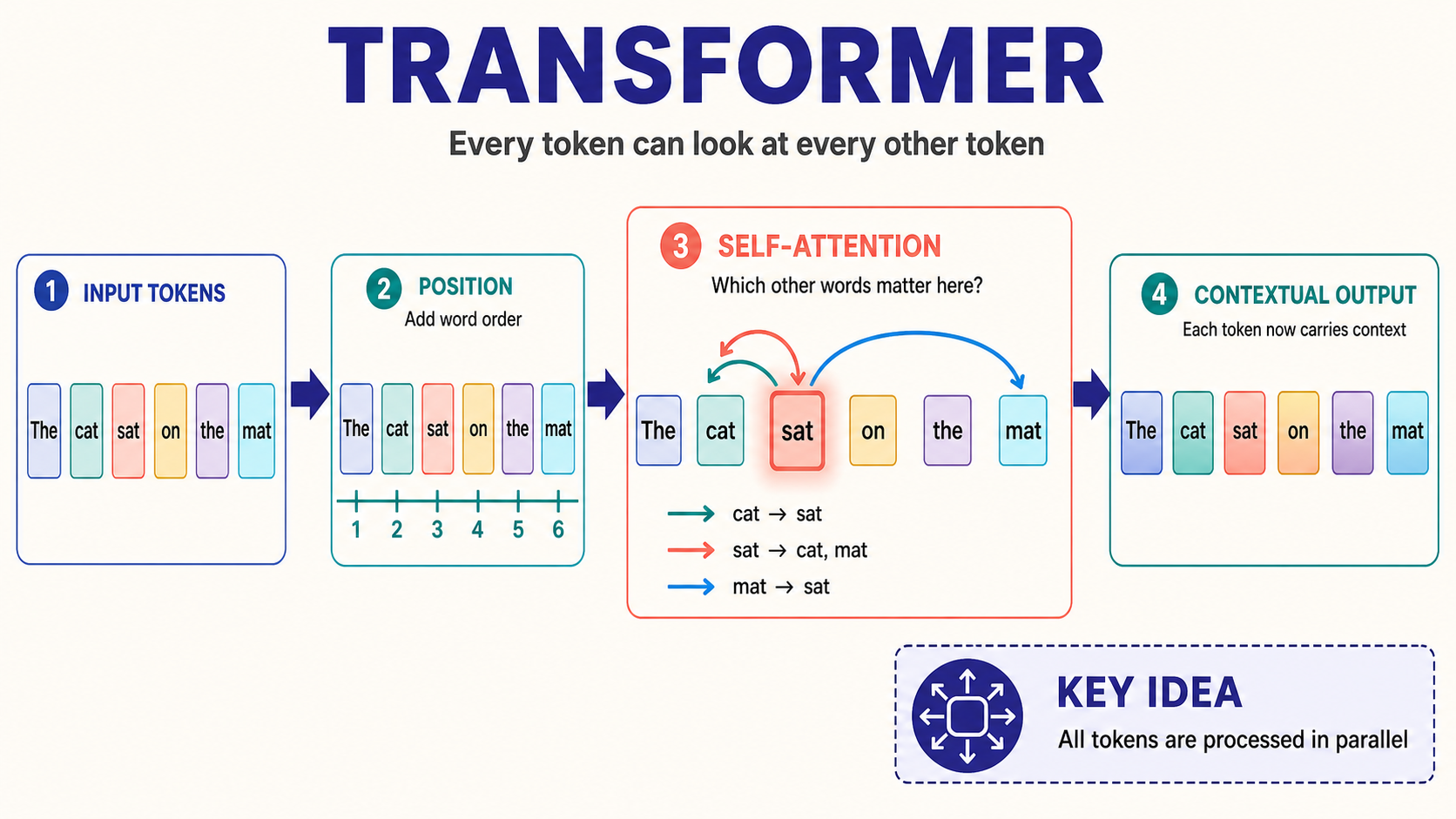
Transformer: The Architecture Behind Modern AI
A Transformer is a neural-network architecture that uses attention to build context-aware representations of tokens, allowing many sequence positions to be processed in parallel.
#neural networks#attention#model architectureRead entry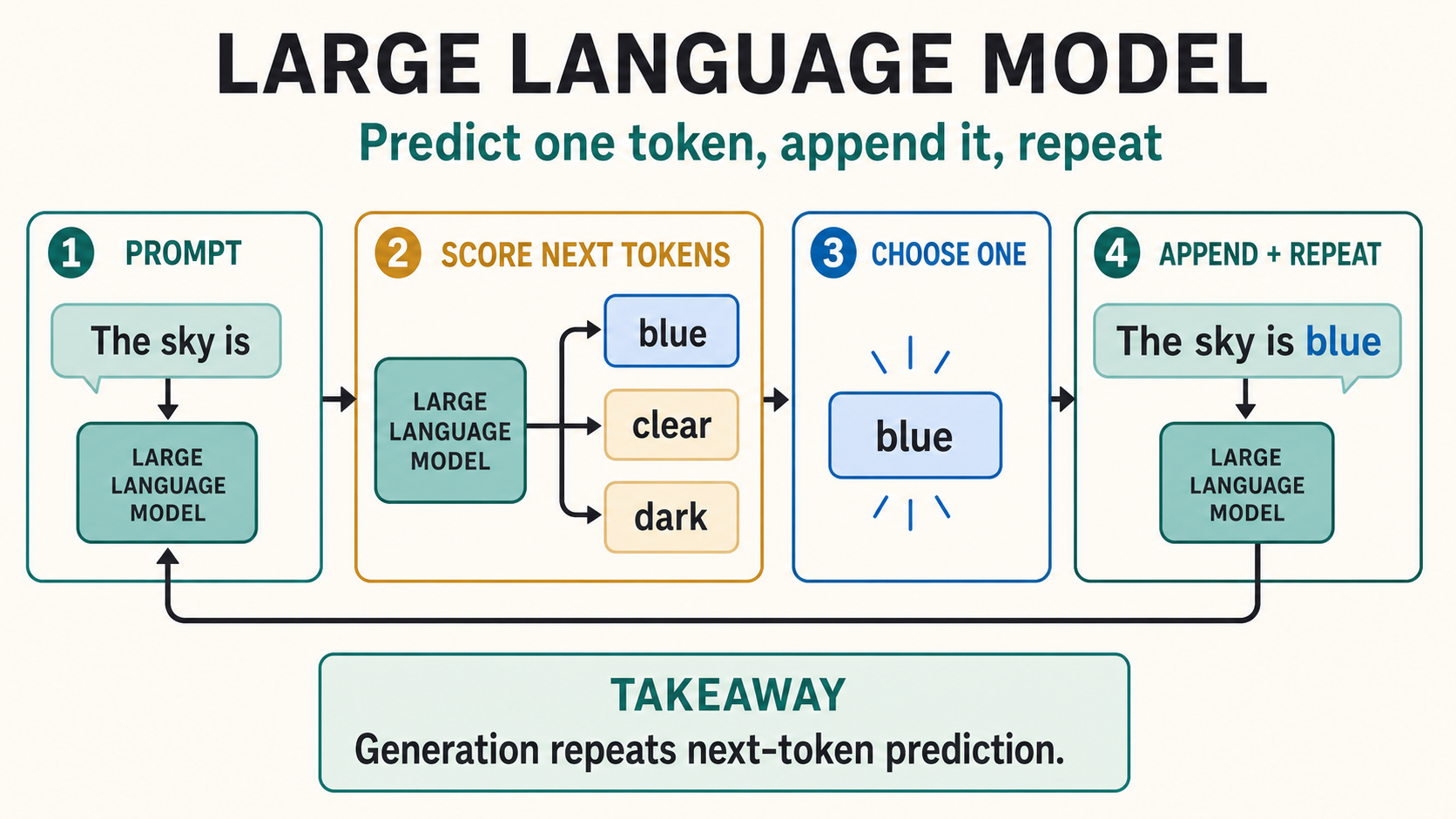
Models & Architecture
Large Language Models (LLMs): How They Generate Text
A large language model is a neural network trained on extensive language data to estimate patterns in token sequences, enabling it to generate or represent text for many downstream tasks.
#language models#generative AI#transformersRead entry