
Chain-of-Thought Prompting: Step-by-Step Answers
Also known as: CoT prompting · Chain of thought · Step-by-step prompting
Definition
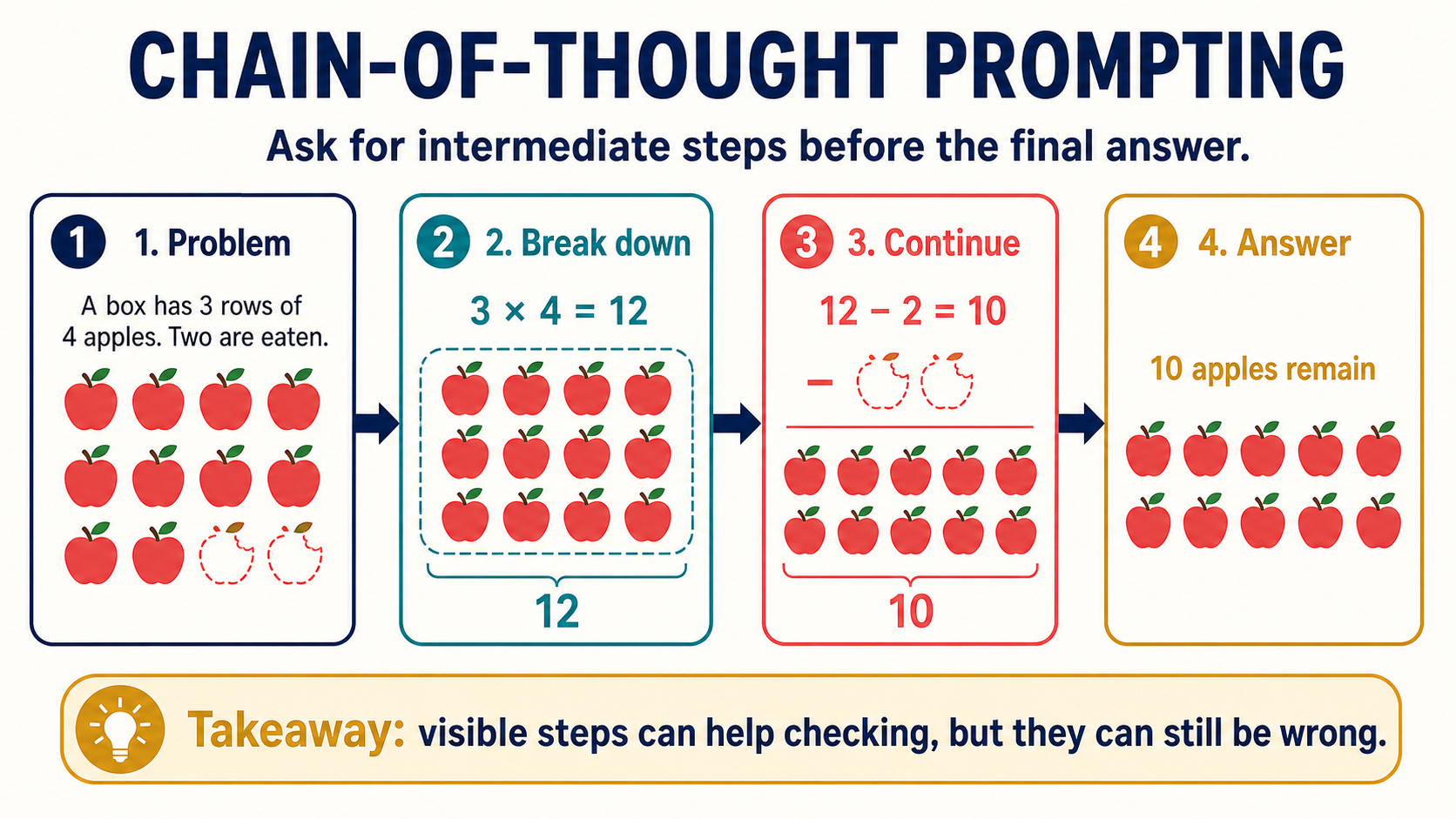
Chain-of-thought prompting asks a language model to produce intermediate natural-language steps before giving a final answer, often through worked examples or an explicit step-by-step instruction.
Contents
Chain-of-thought prompting is a technique for eliciting an intermediate explanation or calculation from a language model before it states a final answer. Instead of mapping a question directly to a short result, the prompt encourages a sequence such as identifying quantities, applying a rule, and checking a conclusion.
The original chain-of-thought research demonstrated the method with worked examples in the prompt. Later work showed that a simple instruction such as asking a sufficiently capable model to think step by step could also improve results on some benchmark tasks. These findings are empirical, not a guarantee that every model, problem, or wording benefits.
Simple analogy
Imagine a student solving a word problem on paper. A bare answer gives the teacher only a number. A worked solution exposes the multiplication, subtraction, or logical transitions that led to it. The teacher can inspect those visible steps and find where an error occurred.
The analogy has an important limit. A language model generates a plausible written solution token by token. Its explanation is not a direct recording of hidden mental activity, and a fluent sequence can contain an incorrect assumption or quietly change the problem. Treat the generated steps as an answer artifact to examine, not as guaranteed evidence of faithful internal reasoning.
How it works
In few-shot chain-of-thought prompting, a prompt includes several demonstrations. Each demonstration contains a question, a sequence of intermediate steps, and a final answer. The model then receives a new question and continues the demonstrated pattern. The examples teach both the task format and the expected style of decomposition through in-context learning; the model’s parameters are not updated.
In zero-shot chain-of-thought prompting, the prompt contains no worked examples. It instead includes an instruction intended to elicit an intermediate solution, such as asking for a step-by-step approach. The Zero-shot-CoT paper found strong gains for particular large models and reasoning benchmarks, but the size and direction of the effect depend on the model, task, prompt, and evaluation setup.
The useful unit is not the phrase itself but the decomposition it encourages. A good prompt can ask the model to identify known facts, separate subproblems, apply constraints, show calculations, and then state the answer clearly. For tasks where a private answer is preferable, an application can instead ask for a concise justification, structured evidence, or independently checkable calculations rather than a long free-form rationale.
Self-consistency is a related decoding method. Instead of generating one chain and accepting its answer, the system samples several different reasoning paths and selects the answer that appears most consistently across them. The technique improved results on several arithmetic and commonsense benchmarks in its original study. It costs more inference because the model must generate multiple candidates, and agreement can still converge on the same wrong answer.
Chain-of-thought output should be paired with verification. Arithmetic can be recalculated with code, factual claims can be checked against retrieved sources, and constraints can be tested mechanically. The generated chain can help locate what to verify, but it does not replace verification.
Why it matters
Many useful tasks require more than recalling a phrase. They involve combining several conditions, transforming quantities, comparing alternatives, or following a multistep procedure. Asking for intermediate steps can give a model more output space in which to represent those transformations and can make a response easier for a person or program to inspect.
The technique also changed how practitioners evaluate prompting. A model that fails when asked for only a final answer may perform differently when the response format supports decomposition. Conversely, a model can generate an impressive explanation while ending with a wrong answer. Evaluation therefore needs to score the result and, when relevant, the validity of the supporting steps.
Chain-of-thought prompting is inexpensive to try because it does not require model training. That makes it useful for prototypes and prompt experiments. The operational cost may still increase: intermediate text consumes tokens, adds latency, and may expose sensitive details if prompts or outputs are logged without care.
Practical use cases
For arithmetic word problems, a prompt can require explicit quantities, operations, units, and a final check. For planning, it can ask the model to break a goal into ordered prerequisites and identify unresolved assumptions. For classification, a short justification can reveal which evidence drove the label and help reviewers catch an unsupported category.
In coding assistance, the model can outline requirements and edge cases before proposing code. Tests and static checks should still determine whether the implementation is correct. In retrieval-based question answering, an application can ask for a claim-by-claim explanation tied to cited passages, while separately validating that the citations actually support those claims.
Production systems should compare multiple prompt formats on representative data. Measure final-answer quality, latency, token use, failure severity, and how often explanations help reviewers detect errors. A long rationale is not automatically better than a short structured checklist.
Common misconceptions
Chain-of-thought is not a guarantee of correct reasoning. Each intermediate statement is generated and can be false even when it sounds coherent. A correct-looking process may also end with a transcription error.
The written chain is not necessarily a faithful view of internal computation. It is observable output conditioned on the prompt. Do not treat it as a transparent trace of how the model truly reached its answer.
One magic phrase does not work uniformly. Few-shot demonstrations, task structure, model capability, decoding settings, and answer format all affect results. Some easy tasks gain nothing, while excessive instructions can distract the model.
Longer is not always better. Extra steps increase cost and create more places for unsupported claims. The appropriate format may be a concise derivation, a table of constraints, tool-verified calculations, or only the final answer.
Self-consistency is not proof. Sampling several paths and taking the most common result can improve average benchmark performance, but correlated errors and shared misconceptions remain possible.
Chain-of-thought prompting is best viewed as an interface pattern for eliciting decomposed answers. Its value comes from measured task improvement and stronger verification workflows, not from assuming that fluent explanations are inherently trustworthy.
Frequently asked questions
What is the difference between few-shot and zero-shot chain-of-thought prompting?
Few-shot CoT provides worked question-and-reasoning examples in the prompt. Zero-shot CoT uses an instruction intended to elicit intermediate steps without demonstrations.
Does chain-of-thought prompting reveal a model's true internal reasoning?
No. It produces an observable natural-language explanation, but that output is not guaranteed to be a faithful record of the model's internal computation.
When should chain-of-thought output be verified?
Whenever correctness matters. Recalculate arithmetic, test code, check constraints, and verify factual claims against authoritative sources or trusted tools.
What does self-consistency add to chain-of-thought prompting?
It samples multiple reasoning paths and selects the answer that is most consistent across them, trading additional inference cost for a possible quality improvement.
Related concepts
Prompting & Inference
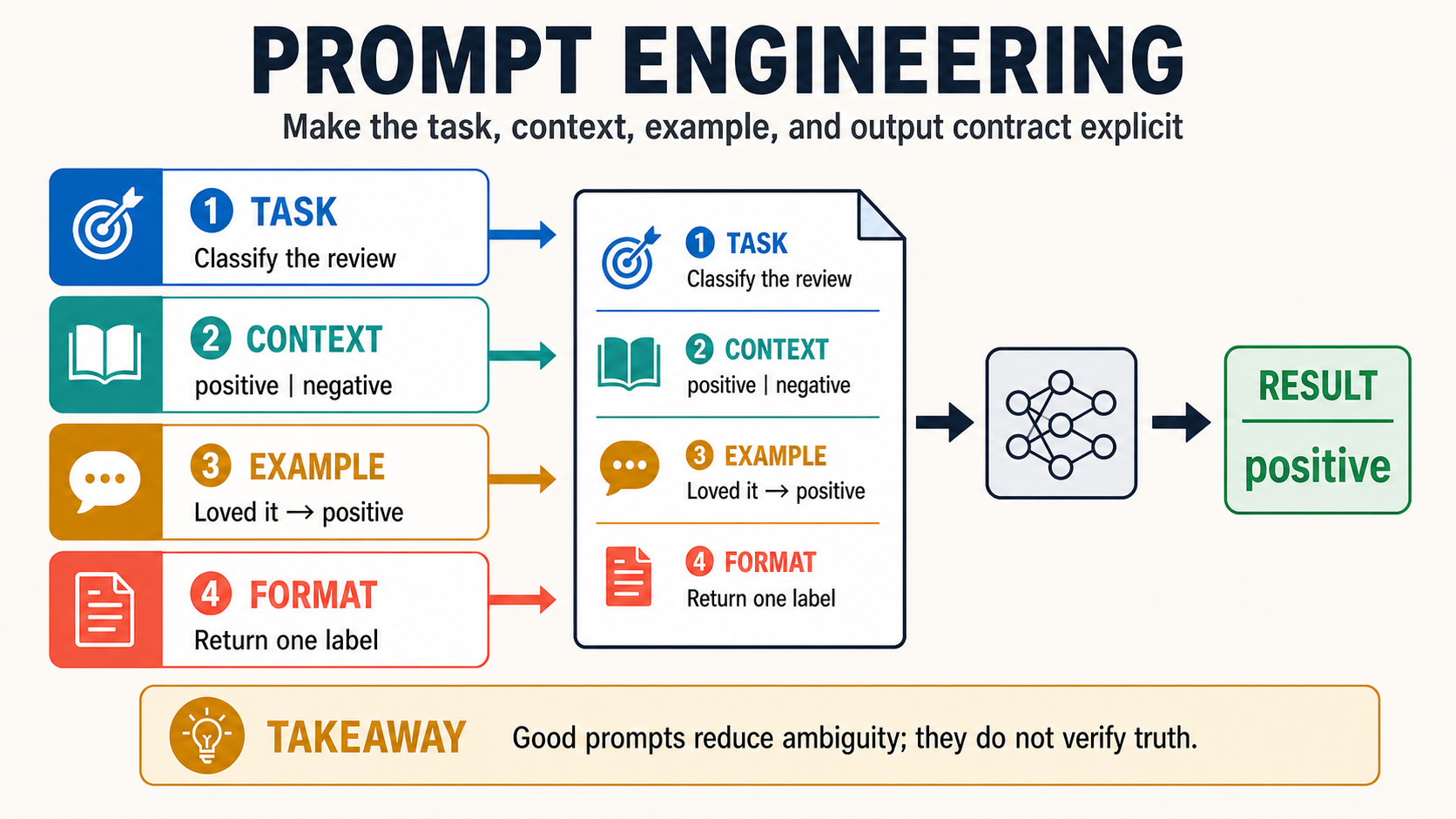
Prompt Engineering: Designing Clear AI Instructions
Prompt engineering is the iterative practice of designing model inputs—such as instructions, context, examples, and output constraints—to improve behavior on a defined task.
#prompting#LLM applications#instructionsRead entry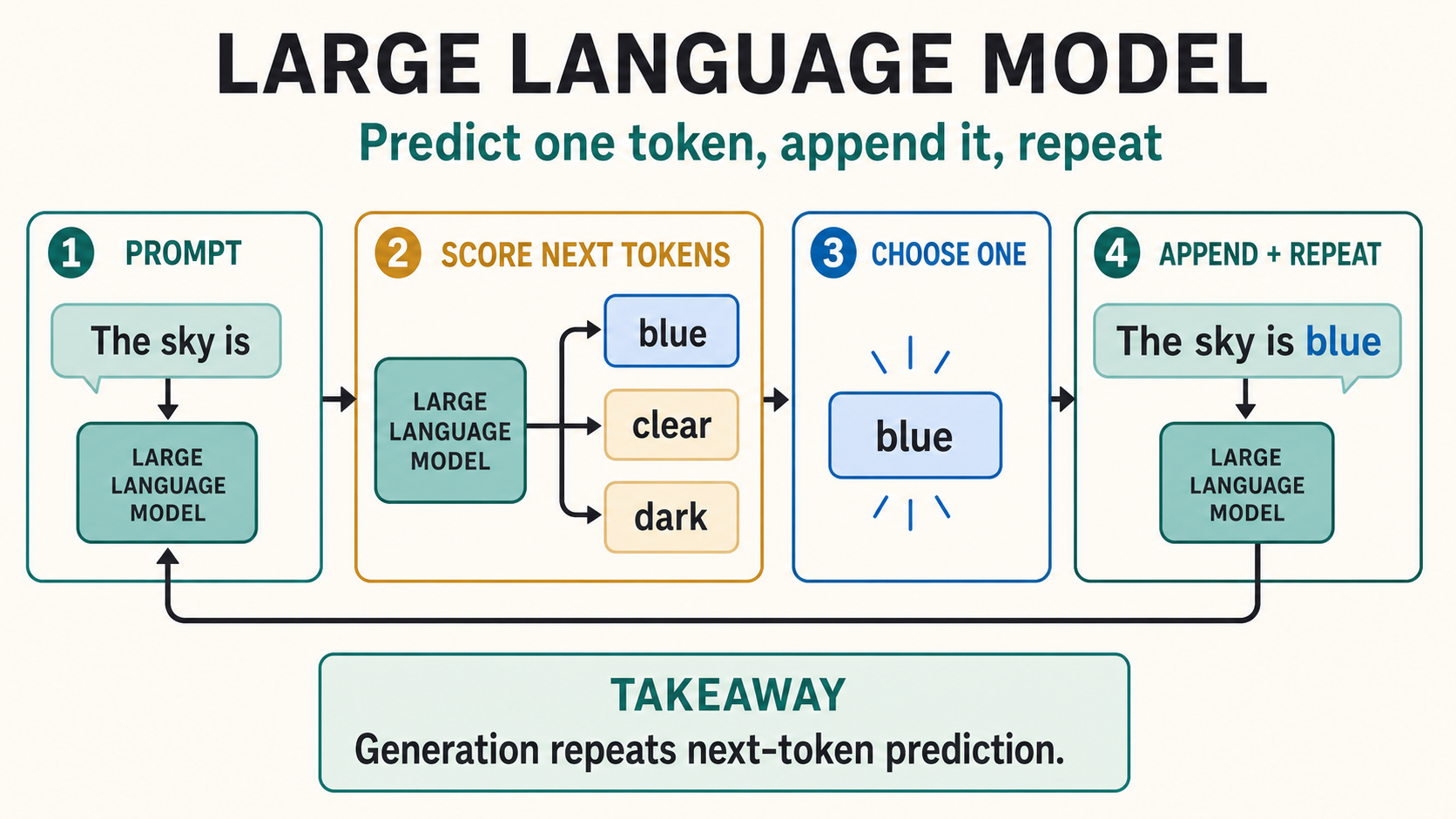
Models & Architecture
Large Language Models (LLMs): How They Generate Text
A large language model is a neural network trained on extensive language data to estimate patterns in token sequences, enabling it to generate or represent text for many downstream tasks.
#language models#generative AI#transformersRead entry