
Prompt Engineering: Designing Clear AI Instructions
Also known as: Prompt design · Prompting
Definition
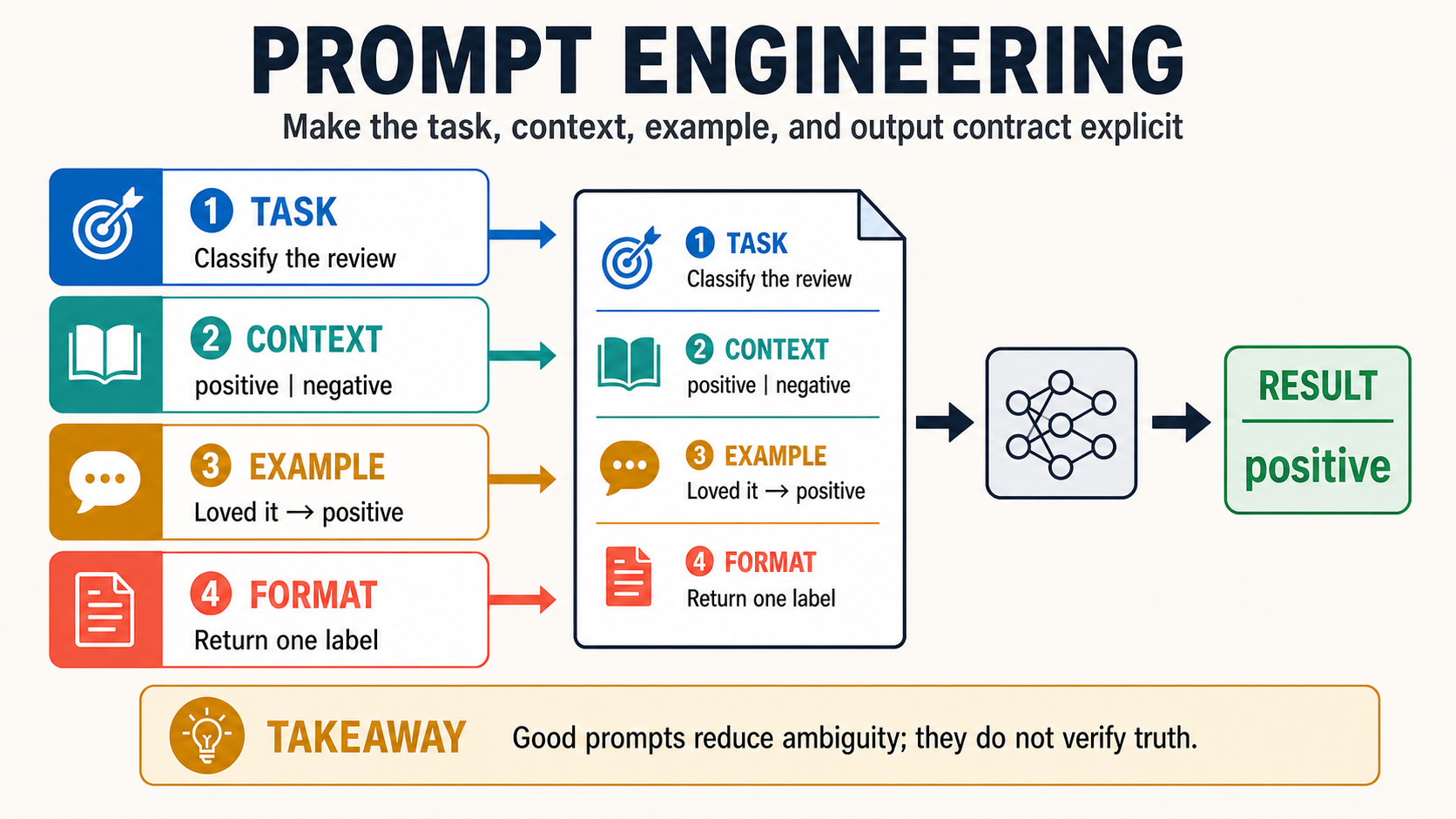
Prompt engineering is the iterative practice of designing model inputs—such as instructions, context, examples, and output constraints—to improve behavior on a defined task.
Contents
Prompt engineering is the practical process of shaping the input given to a generative model so its behavior better matches a specific task. A prompt can include instructions, background context, examples, source material, tool descriptions, and an output contract. The engineering part is not clever wording alone: it includes defining success, testing representative cases, comparing variants, and monitoring how a prompt behaves when models or inputs change.
Simple analogy
Imagine delegating work to a capable new teammate. “Handle this review” leaves many questions unanswered. “Classify the review as positive or negative, use only one label, and follow this example” defines the task, allowed labels, and expected format. The teammate still needs sound judgment, but the clearer request removes avoidable ambiguity.
A prompt plays a similar role for a model. It does not install new permanent knowledge or guarantee truth. It supplies temporary instructions and evidence inside the current context. Better instructions can make an existing capability easier to use, while missing knowledge, unsuitable tools, or unreliable reasoning may require retrieval, fine-tuning, validation, or a different model.
How it works
Define the task and success criteria
A useful prompt starts with an observable goal. “Write something good” is difficult to evaluate; “summarize the incident in five factual bullets for an operations handoff” specifies audience, form, and purpose. Before tuning wording, teams should decide what a correct answer must contain, what it must avoid, and how they will measure success.
Instructions should resolve genuine choices. They can name the role of the output, the allowed evidence, the desired level of detail, and constraints such as a schema. Long lists of redundant or conflicting rules can make behavior less predictable, so priority and consistency matter more than sheer length.
Supply relevant context
Models can only use information present in their parameters or current input. If a task depends on private documents, recent facts, or a user's data, an application may need to retrieve and insert that material. Clear delimiters or structured sections help distinguish instructions from reference text. This separation is also important for security because retrieved content can contain text that looks like an instruction.
Context should be relevant and trustworthy. Dumping a large collection into the prompt can consume the context window, increase cost, and obscure the evidence that matters. The prompt should say how sources are to be used—for example, answer only from supplied passages and identify when the passages are insufficient—but the application must still verify whether the model follows that rule.
Demonstrate with examples
Few-shot prompting places example inputs and outputs in the context. Research on GPT-3 showed that tasks and demonstrations could be specified through text without gradient updates, although performance varied by task. Examples can clarify labels, style, edge cases, and formatting more concretely than abstract instructions.
Examples should represent the desired behavior rather than only easy cases. A classification prompt benefits from examples near category boundaries. A structured extraction prompt benefits from missing fields and unusual ordering. Poor or contradictory examples can teach the wrong pattern for that request.
Chain-of-thought prompting research showed that worked reasoning demonstrations could improve performance on evaluated reasoning tasks for sufficiently large models. That does not imply that every task needs a request for hidden internal reasoning, nor that a visible explanation proves the answer is correct. Modern systems may use internal reasoning processes that should be evaluated through outcomes rather than demanded verbatim.
Specify the output contract
An output contract states what the consumer expects: one label, a Markdown table, valid JSON under a schema, or a concise paragraph. For software integrations, machine-readable structure should use the platform's structured-output capability when available rather than relying only on prose such as “return JSON.”
Constraints should serve the task. A strict one-label output is useful for a classifier but harmful when the model must explain uncertainty. The prompt can also define what to do when evidence is missing, such as returning unknown instead of guessing.
Evaluate and iterate
Prompt changes can trade one failure mode for another. A reliable workflow keeps a test set of ordinary cases, edge cases, adversarial inputs, and unacceptable outputs. Teams compare prompt versions using task-specific metrics and human review where appropriate. They also pin or record model versions because a prompt tuned for one model may behave differently on another.
Why it matters
Prompt engineering is a fast, reversible way to adapt a general model without changing its weights. It can expose capabilities through instructions and examples, standardize output for downstream systems, and connect a model to retrieved data or tools. It is especially useful during prototyping and for tasks whose rules change frequently.
Its limits are equally important. A prompt cannot make a model know unavailable facts, guarantee compliance, or eliminate hallucination. Instructions compete for limited context, and untrusted input can attempt to override them. High-stakes systems need authorization checks, input isolation, output validation, monitoring, and task-level evaluation outside the prompt.
Prompt quality is also model- and task-dependent. Official guidance from model providers differs because interfaces and model behavior differ. Portable principles include clarity, relevant context, representative examples, explicit output expectations, and empirical testing; exact templates should not be treated as universal laws.
Practical use cases
- Classification: Define labels, boundary cases, and a strict output format.
- Extraction: Provide source text, field definitions, and behavior for missing values.
- Summarization: Specify audience, evidence scope, length, and facts that must be retained.
- Code generation: Include interfaces, repository conventions, tests, and acceptance criteria.
- Retrieval-augmented answers: Separate trusted instructions from retrieved evidence and require source-grounded responses.
- Agent tools: Explain tool purposes, argument rules, and when the model should ask for clarification instead of acting.
The best prompt is not necessarily the longest. It is the shortest version that communicates the required decisions, evidence, and output contract while passing a realistic evaluation set.
Common misconceptions
“Prompt engineering is finding magic words.” Reliable prompting is an iterative design and evaluation process. Isolated phrases rarely transfer perfectly across tasks and models.
“A detailed prompt guarantees a correct answer.” Detail can reduce ambiguity, but correctness still depends on model capability, evidence, tools, and validation.
“Examples permanently train the model.” In-context examples affect the current request. They do not normally update model weights.
“Prompt injection can be solved by telling the model to ignore it.” Defensive instructions can help, but secure systems also separate trust boundaries, restrict tool permissions, validate actions, and treat model output as untrusted.
Frequently asked questions
What is the difference between prompting and fine-tuning?
Prompting supplies temporary instructions and examples inside the context. Fine-tuning updates model parameters using a training process and dataset, making it a less immediate but potentially more persistent adaptation.
How many examples should a prompt include?
There is no universal number. Include enough representative examples to clarify the task without crowding out the actual input, then measure whether additional examples improve the evaluation set.
Should prompts ask a model to show every reasoning step?
Not by default. Some research prompts use worked reasoning examples, but production systems should follow model-specific guidance and judge correctness with outcomes, evidence, and tests rather than assuming a visible rationale is faithful.
Why can a good prompt stop working after a model change?
Models differ in training, instruction following, tokenization, and decoding behavior. Record the model version and rerun prompt evaluations whenever the model or surrounding context pipeline changes.
Related concepts
Models & Architecture
Large Language Models (LLMs): How They Generate Text
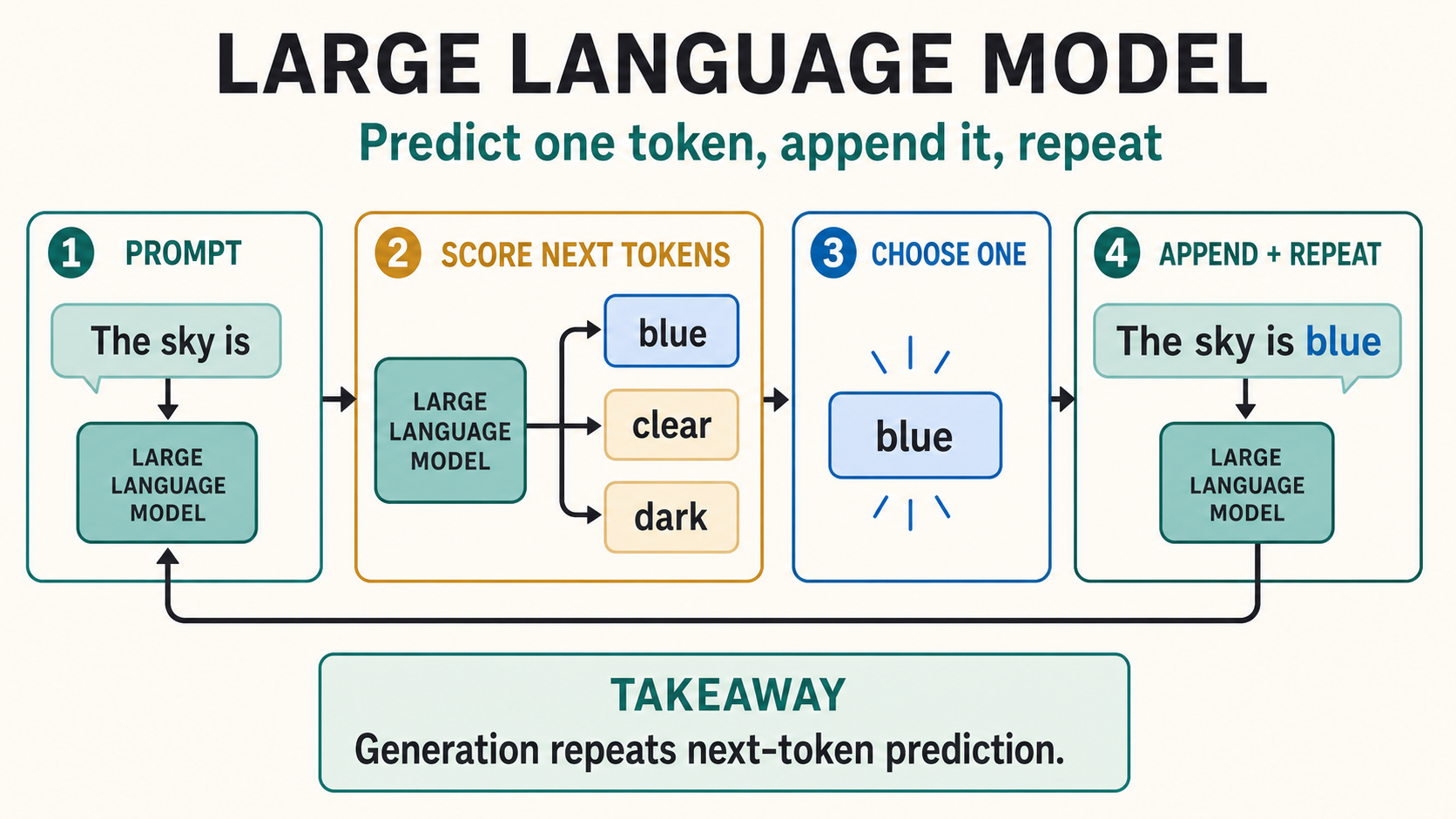
A large language model is a neural network trained on extensive language data to estimate patterns in token sequences, enabling it to generate or represent text for many downstream tasks.
#language models#generative AI#TransformersRead entry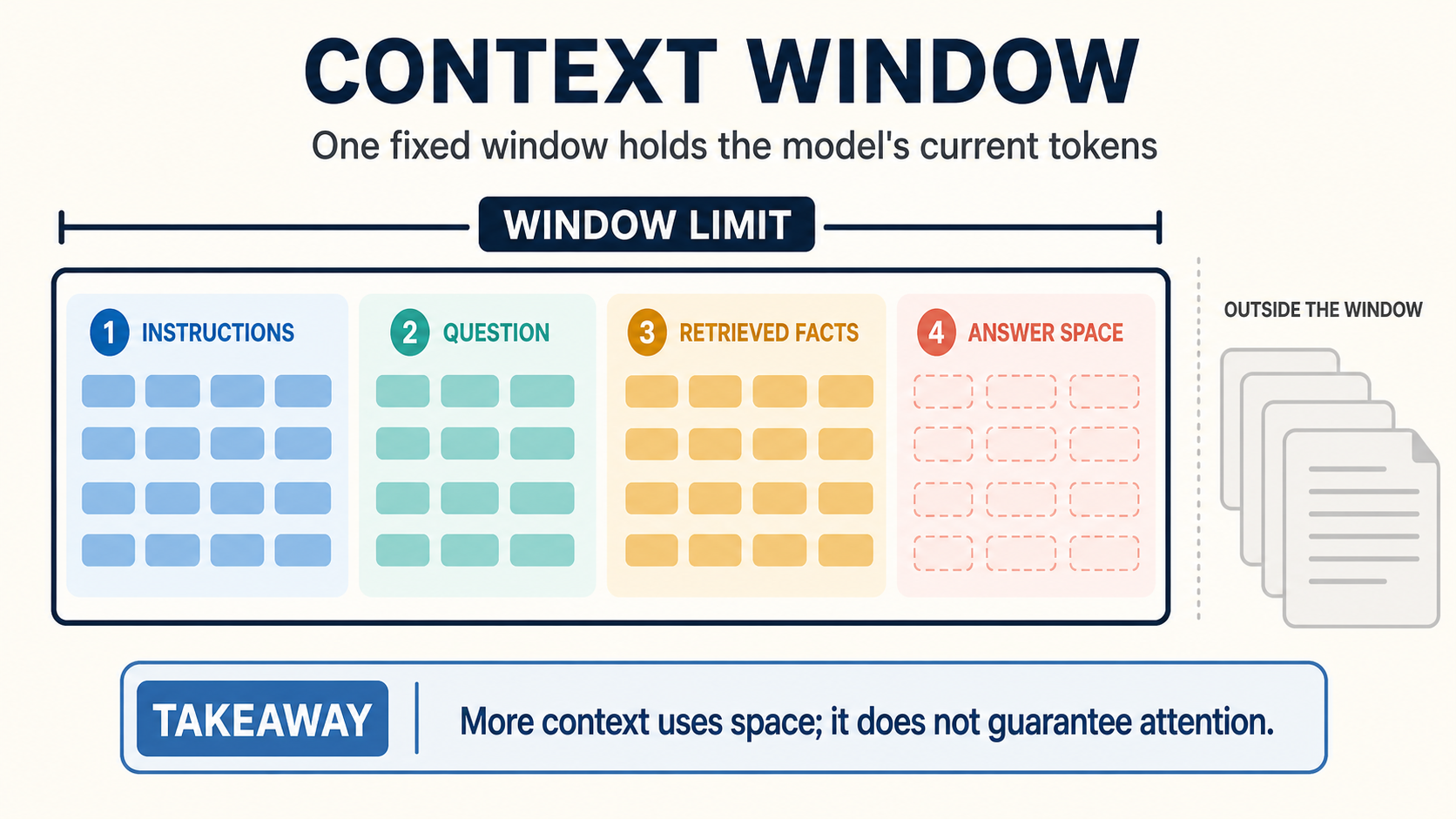
Foundations
Context Window: What an AI Model Can Use at Once
A context window is the bounded sequence of tokens a model can process as its current input and, for a generative model, the growing output history it can condition on while generating.
#tokens#LLM limits#promptingRead entry