
Context Window: What an AI Model Can Use at Once
Also known as: Context length · Token window · Sequence length
Definition
A context window is the bounded sequence of tokens a model can process as its current input and, for a generative model, the growing output history it can condition on while generating.
Contents
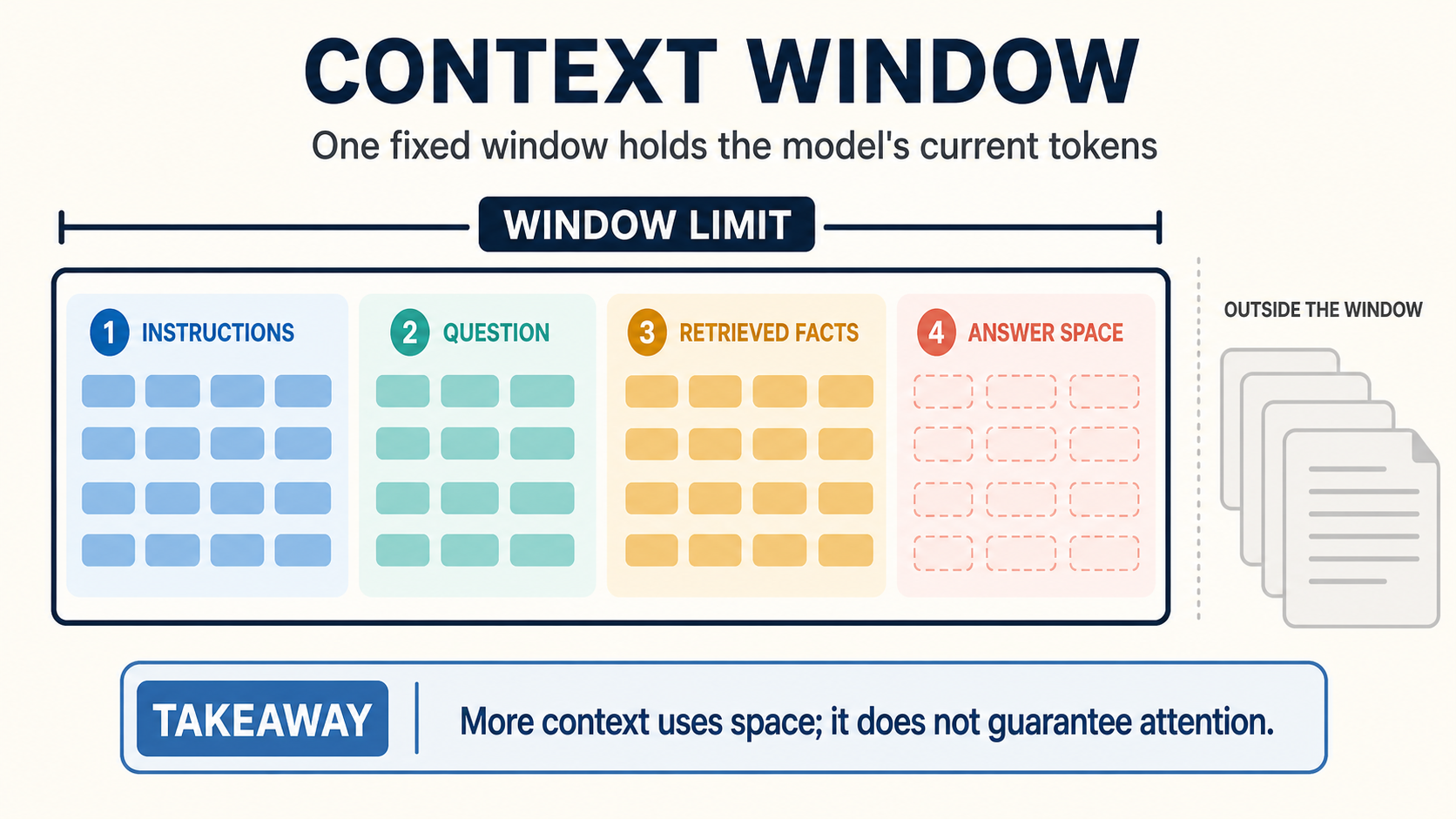
A context window is the finite span of tokens available to a model during one computation or generation sequence. For a conversational language model, that span can contain system instructions, prior messages, a new question, retrieved documents, tool results, and tokens the model has already generated. Anything not included in the current sequence cannot directly influence the next-token calculation, even if the user saw it earlier in an interface.
Simple analogy
Think of the context window as a fixed-size workbench. Instructions, reference documents, the user's request, and space for the answer all occupy the same bench. A larger bench can hold more material, but merely placing a page on it does not guarantee that the worker will notice the right sentence or use it correctly. Pages left in a filing cabinet are unavailable until someone retrieves and places them on the bench.
The analogy also explains why context is not permanent memory. When a new request is assembled, the application decides what to put on the workbench again. A chat product may store earlier messages in a database, summarize them, or retrieve selected details, but those storage systems are outside the model's context window.
How it works
Count the sequence in tokens
Text is first converted into tokens by the tokenizer paired with the model. Token count, not word count or character count, determines how much sequence space the text consumes. Different tokenizers can split the same sentence differently, so a model-specific tokenizer is required for accurate planning. Images, audio, or other modalities may also be represented through model-specific token-like units.
A context limit is usually stated as a maximum number of tokens. Product interfaces can impose additional input or output limits, so the usable budget may be smaller than the architecture's theoretical sequence length. Applications should consult the specific model interface rather than assume that a general model family always has one fixed limit.
Assemble the current context
Before inference, an application constructs an ordered sequence. It may include instructions that define behavior, conversation history, examples, retrieved facts, tool outputs, and the latest user message. Roles and separators are encoded according to the model's input format. The model sees the resulting token sequence, not the application's database rows or visual chat bubbles.
For an autoregressive model, generated tokens are appended to the sequence and become context for later tokens. This means output needs space too. If an application fills nearly the entire allowed input with documents, it may leave insufficient room for the requested answer. Some APIs expose separate maximum-output controls, but generation still has a bounded operational budget.
Represent position and relationships
Transformer attention lets token representations combine information from other permitted positions. Positional information is necessary because attention alone does not identify token order. The original Transformer added positional encodings, while later approaches include learned positions, relative position methods, and rotary position embeddings. These choices affect how a model represents distance and can influence its behavior at longer sequence lengths.
Computational cost also matters. Standard self-attention constructs relationships across pairs of positions, so its memory and computation grow rapidly as a sequence gets longer. Architectures and inference systems use techniques such as sparse or local attention, caching, compression, and optimized kernels to manage long contexts, but each introduces engineering tradeoffs.
Handle overflow
When material exceeds the available window, an application must choose what remains. Simple truncation removes tokens from one end. Sliding windows retain a recent span. Summarization compresses older content but can lose details. Retrieval selects only passages judged relevant to the current query. Structured memory stores facts externally and reinserts selected records later.
The choice is part of application design. Keeping only recent messages may discard an early constraint, while keeping everything may increase cost and distract the model. A robust system measures whether its selection strategy preserves the information actually needed for the task.
Why it matters
Context length defines a hard capacity boundary, but effective context use is a separate question. Research on long-context language models found that performance could change with the position of relevant information, with some evaluated models performing worse when key evidence appeared in the middle of a long input. A model accepting a document therefore does not prove that it used every part reliably.
Longer contexts can increase latency, memory use, and inference cost. They can also introduce irrelevant or conflicting instructions, duplicate evidence, and more opportunities for malicious text inside retrieved content. Good context management aims for sufficient, high-quality evidence rather than maximum volume.
The window also shapes product behavior. Chat history may appear continuous to a user even when the application summarizes or drops older turns. Retrieval-augmented generation exists partly because external collections are larger than any single context: a retriever chooses a small candidate set to place into the model's current sequence.
Practical use cases
- Conversation management: Retain recent turns, summarize older discussion, and preserve durable user preferences outside the immediate window.
- Document question answering: Select relevant sections instead of inserting an entire collection blindly.
- Coding assistants: Include the active file, related definitions, errors, and repository instructions while excluding unrelated source files.
- Agent workflows: Add tool definitions, observations, intermediate state, and task instructions without letting stale traces overwhelm the next decision.
- Prompt budgeting: Reserve enough capacity for examples, retrieved evidence, and the expected response.
- Long-form generation: Carry outlines and completed sections forward while periodically compressing or validating earlier constraints.
Teams should test context strategies with realistic document lengths and evidence positions. A small benchmark containing only short, clean prompts cannot reveal long-context retrieval failures or truncation bugs.
Common misconceptions
“A larger context window is permanent memory.” The window is temporary input. Persistence requires an external store and a policy that chooses what to bring back into later contexts.
“If text fits, the model will use it correctly.” Capacity is not attention quality. Relevant details can be overlooked, diluted by noise, or interpreted incorrectly.
“One token equals one word.” Tokens may be words, subwords, punctuation, bytes, or special markers. Context should be measured with the correct tokenizer.
“More context always improves an answer.” Extra material can help when it is relevant and trustworthy, but irrelevant, conflicting, or adversarial content can reduce quality and increase cost.
Frequently asked questions
Does the answer count toward the context window?
For autoregressive generation, previously generated tokens become part of the sequence used to predict later tokens. APIs may describe input and output limits separately, so applications should follow the exact model contract.
What happens when a prompt is too long?
The API may reject it, or an application may truncate, summarize, or retrieve a smaller subset before sending it. Silent truncation is risky because it can remove important instructions or evidence.
Is context length the same for every model?
No. Limits and supported modalities vary by model and deployment. They can also change between versions, so current model documentation is the source of truth for an integration.
How can an application remember more than the window holds?
It can store conversation, documents, or structured facts externally, then use retrieval, summaries, or rules to insert the most relevant material into each new context.
Related concepts
Foundations
Tokenization: How AI Models Break Text into Tokens
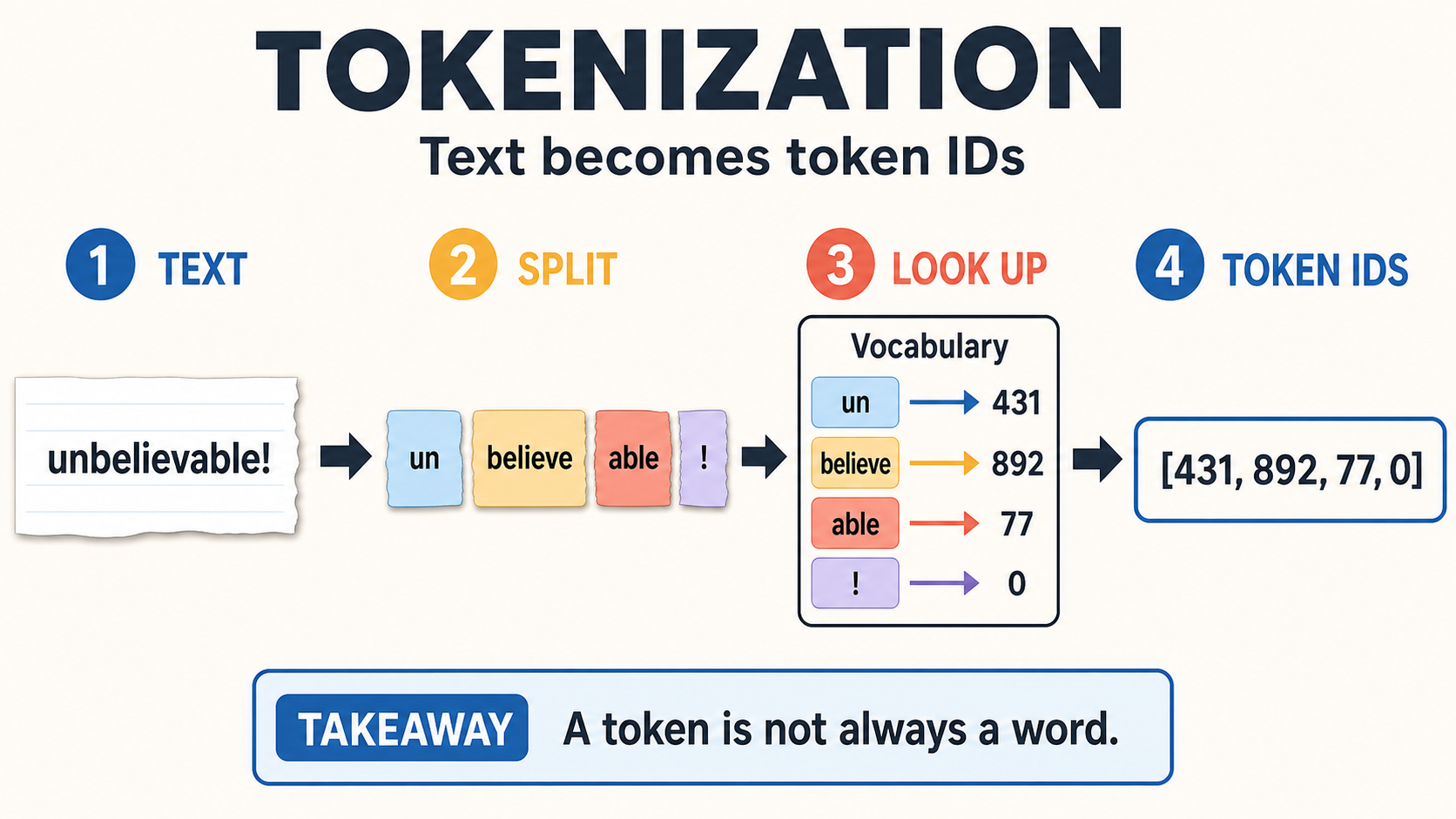
Tokenization is the process of converting text or another input into a sequence of discrete units called tokens, then mapping those tokens to numeric identifiers that a model can process.
#tokens#NLP#text processingRead entry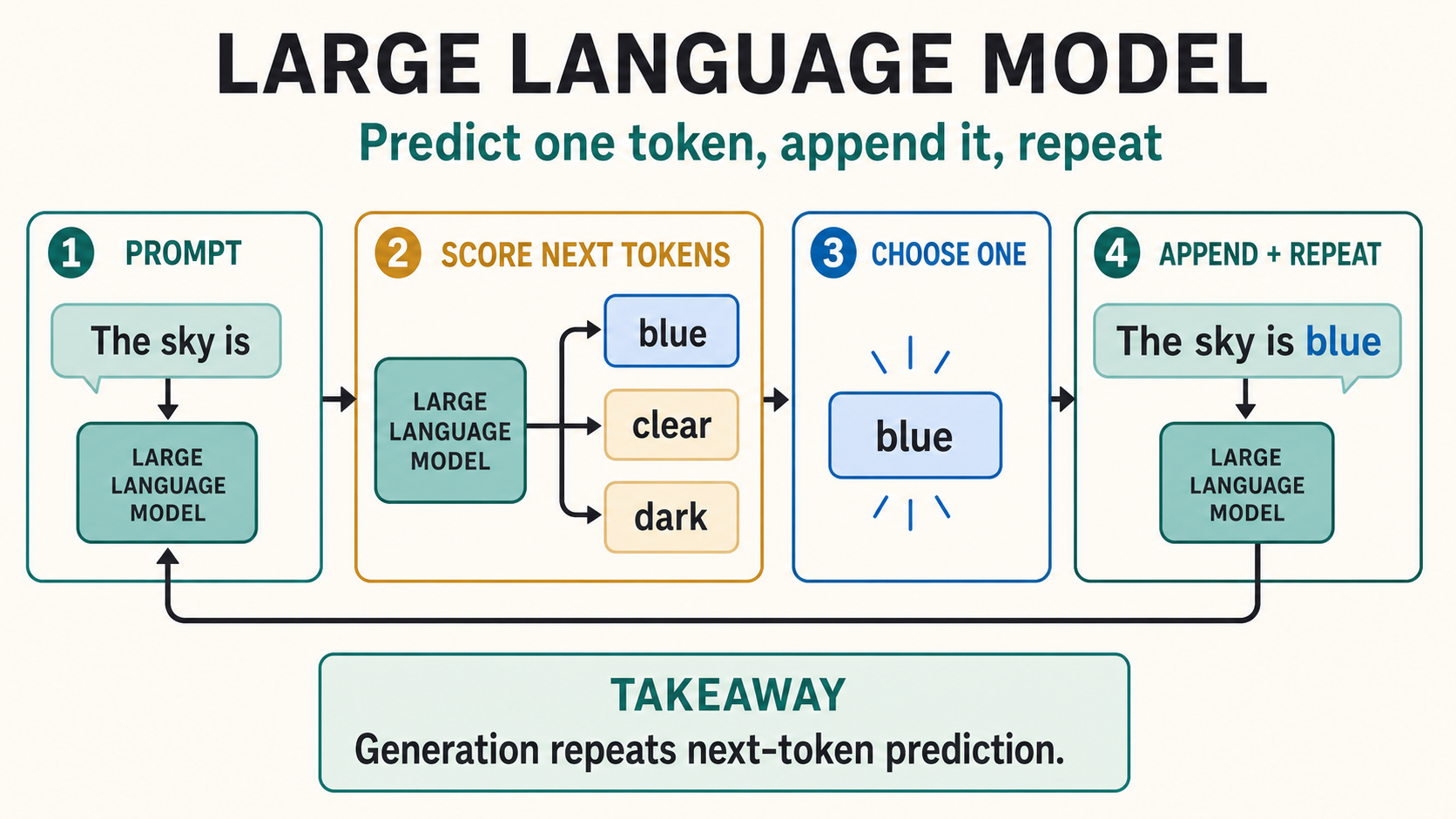
Models & Architecture
Large Language Models (LLMs): How They Generate Text
A large language model is a neural network trained on extensive language data to estimate patterns in token sequences, enabling it to generate or represent text for many downstream tasks.
#language models#generative AI#TransformersRead entry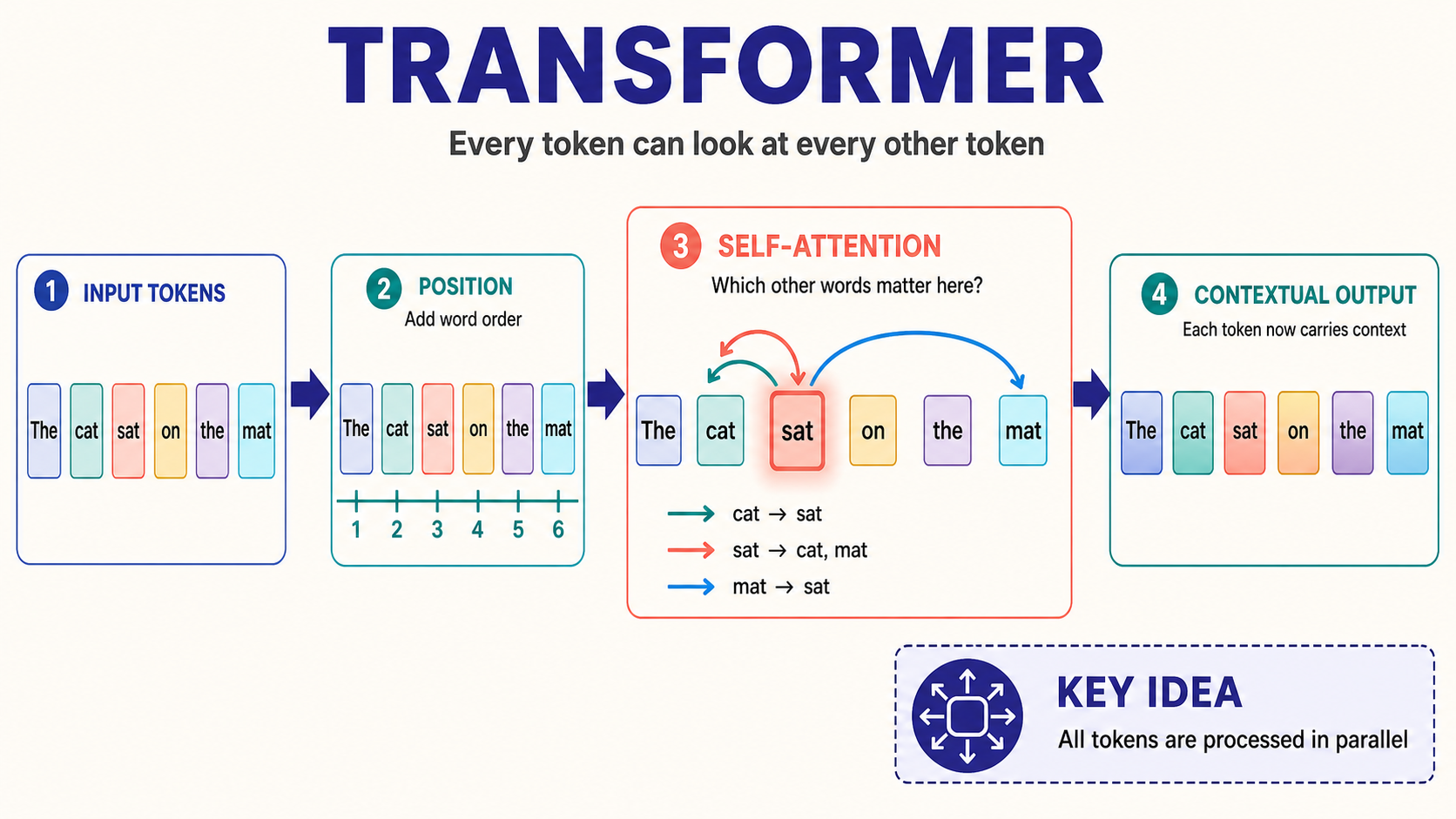
Models & Architecture
Transformer: The Architecture Behind Modern AI
A Transformer is a neural-network architecture that uses attention to build context-aware representations of tokens, allowing many sequence positions to be processed in parallel.
#neural networks#attention#model architectureRead entry