
Fine-Tuning: Adapting a Pretrained AI Model
Also known as: Model Fine-Tuning · Supervised Fine-Tuning · SFT
Definition
Fine-tuning continues training a pretrained model on a more focused dataset so that some or all of its parameters adapt to a target task, domain, or behavior.
Contents
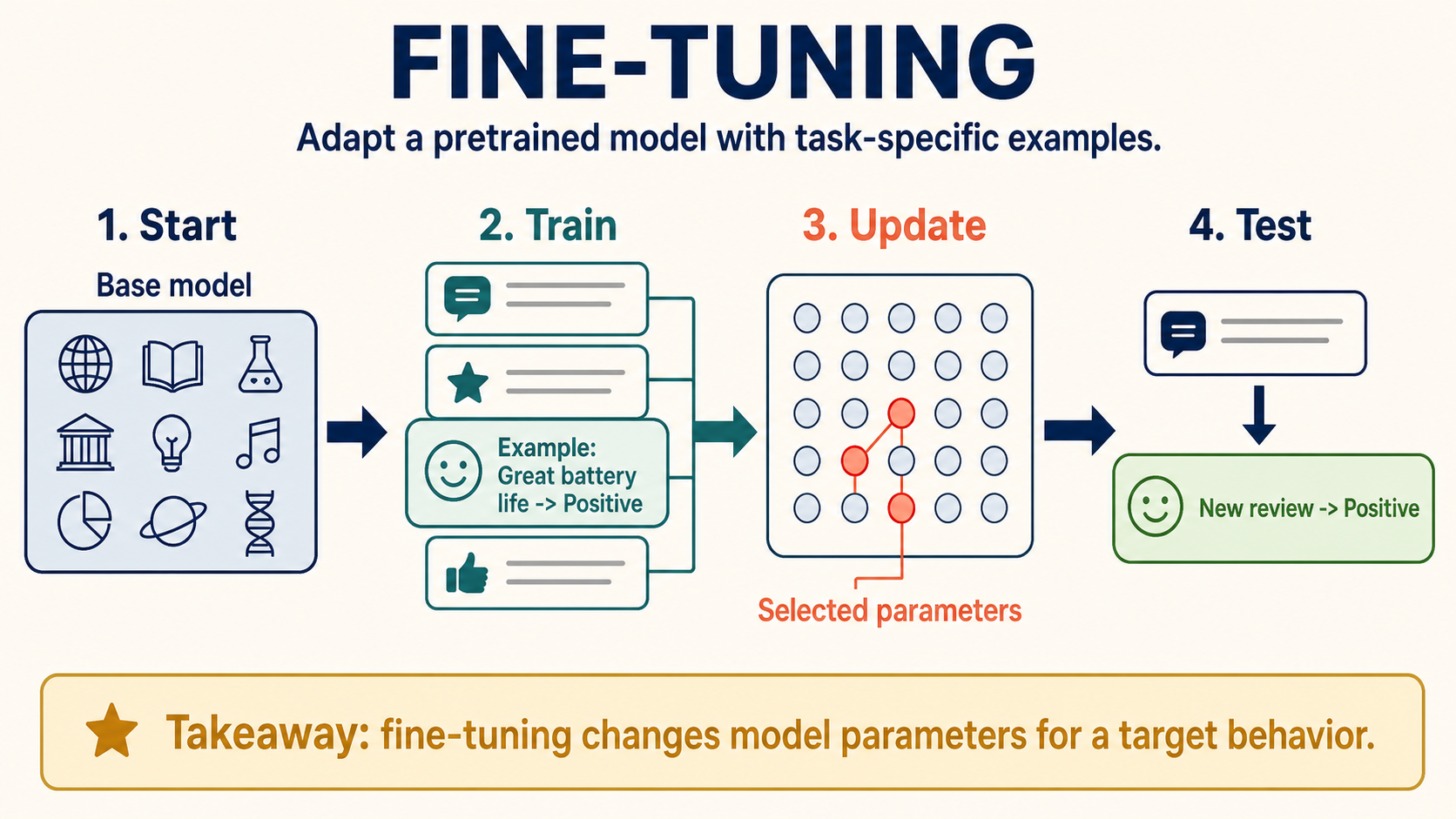
Fine-tuning adapts an existing pretrained model instead of training a new model from the beginning. The starting model already contains broadly useful learned representations; a second training stage uses a narrower dataset and objective to make its behavior more suitable for a particular task or domain.
Simple analogy
Think of a broadly educated writer beginning a job at a medical publisher. The writer does not relearn language from scratch. Instead, they study approved examples, terminology, and editorial decisions until their work better matches the new role.
Fine-tuning follows the same broad pattern. A base model supplies general capabilities, while curated examples provide corrective signals for the target behavior. The analogy has limits: a neural model changes numerical parameters through optimization rather than consciously learning rules, and the quality of its adaptation depends heavily on the data and evaluation process.
How it works
A team first selects a pretrained checkpoint and defines the desired behavior. The target might be sentiment classification, domain-specific extraction, instruction following, a consistent response format, or another measurable task. They then prepare training examples whose inputs and desired outputs demonstrate that behavior.
During training, the model makes predictions on batches of examples. A loss function measures the difference between its predictions and the desired outputs. Backpropagation computes gradients, and an optimizer uses those gradients to adjust trainable parameters. Learning rates are usually lower than in pretraining because the goal is controlled adaptation, not wholesale relearning.
In full fine-tuning, all or most model parameters are trainable. This offers substantial flexibility but requires memory for the model, gradients, and optimizer state. It also produces a complete adapted checkpoint for each use case.
Parameter-efficient fine-tuning (PEFT) trains a smaller set of parameters. LoRA, for example, freezes the original weights and learns low-rank update matrices that modify selected layers during use. Adapter-based approaches add small trainable modules. These methods can reduce training and storage requirements, but they do not make data quality or evaluation optional.
Supervised fine-tuning uses labeled input-output examples. Instruction tuning is a related use of fine-tuning in which the dataset contains many tasks expressed as instructions, helping a model respond more usefully to unfamiliar instructions. Other post-training stages may optimize preference or reward signals, but those are distinct objectives even when people casually group them under “fine-tuning.”
A sound workflow separates training, validation, and test data. Training examples update the model. Validation data helps choose settings and detect overfitting. A held-out test set estimates how well the finished model generalizes. Teams should also compare the tuned model with the base model, because improvement on a narrow target can coincide with regression elsewhere.
Why it matters
Pretraining is expensive and general. Fine-tuning reuses that investment and can produce useful specialization with much less task-specific data and computation than starting over. The BERT work demonstrated a widely influential pattern: pretrain a general representation, then fine-tune it for downstream language tasks with relatively small architectural changes.
Fine-tuning can make behavior more consistent than relying on prompting alone. It can teach a stable output format, decision boundary, terminology style, or task procedure that appears repeatedly. Parameter-efficient methods also make it practical to maintain multiple adaptations of one base model.
The main risks are overfitting, catastrophic forgetting, and unintended behavior changes. A narrow or biased dataset can teach brittle shortcuts. Too-aggressive optimization can damage capabilities learned during pretraining. Sensitive or copyrighted material in training examples can also create governance and privacy concerns.
Practical use cases
Classification is a classic use case: a pretrained text model can be tuned to label support tickets, detect intent, or categorize documents. Extraction systems can be tuned to return specific fields from recurring document types. Generative models can be adapted to follow a house style, produce a validated structure, or handle specialized terminology.
Fine-tuning is useful when the desired pattern is stable and many high-quality examples are available. It is less suitable when the primary need is frequently changing factual knowledge. In that case, retrieval-augmented generation or tool access can supply current information without repeatedly changing model weights.
Teams often combine methods. A fine-tuned model may provide reliable task behavior, a prompt may specify the current request, and retrieval may provide up-to-date evidence. These components solve different problems and should be evaluated separately and together.
Common misconceptions
Fine-tuning is not the same as adding documents to a searchable knowledge base. Training changes parameters; retrieval supplies external content at inference time. A tuned model does not automatically cite or faithfully reproduce its training sources.
More examples are not automatically better. Duplicates, inconsistent labels, leakage from the test set, and low-quality synthetic data can reduce reliability. Coverage and correctness matter more than raw volume.
Fine-tuning does not guarantee factual accuracy or safety. It can reduce specific observed errors, but new inputs may expose failures. High-stakes uses still require verification, monitoring, and appropriate human oversight.
PEFT is still fine-tuning. Freezing the base weights does not mean the system is unchanged; learned adapters or low-rank updates alter its behavior. The distinction concerns which parameters are trained and stored.
A lower training loss does not prove deployment success. The model must be tested on representative held-out data, including edge cases and regressions outside the narrow training distribution.
Frequently asked questions
How is fine-tuning different from prompting?
Prompting changes the input context for a particular request, while fine-tuning uses training examples and optimization to change trainable model parameters for future requests.
What is parameter-efficient fine-tuning?
It is a family of methods that adapts a model by training a relatively small parameter set, such as adapters or LoRA updates, while keeping most or all base weights frozen.
Can fine-tuning teach a model current facts?
It can influence parameterized knowledge, but it is usually a poor substitute for a current, traceable information source. Retrieval or tools are better suited to frequently changing facts.
How do you know whether a fine-tuned model is better?
Compare it with the base model on held-out, representative evaluations for the target behavior, safety requirements, edge cases, and important general capabilities that must not regress.
Related concepts
Models & Architecture
Large Language Models (LLMs): How They Generate Text
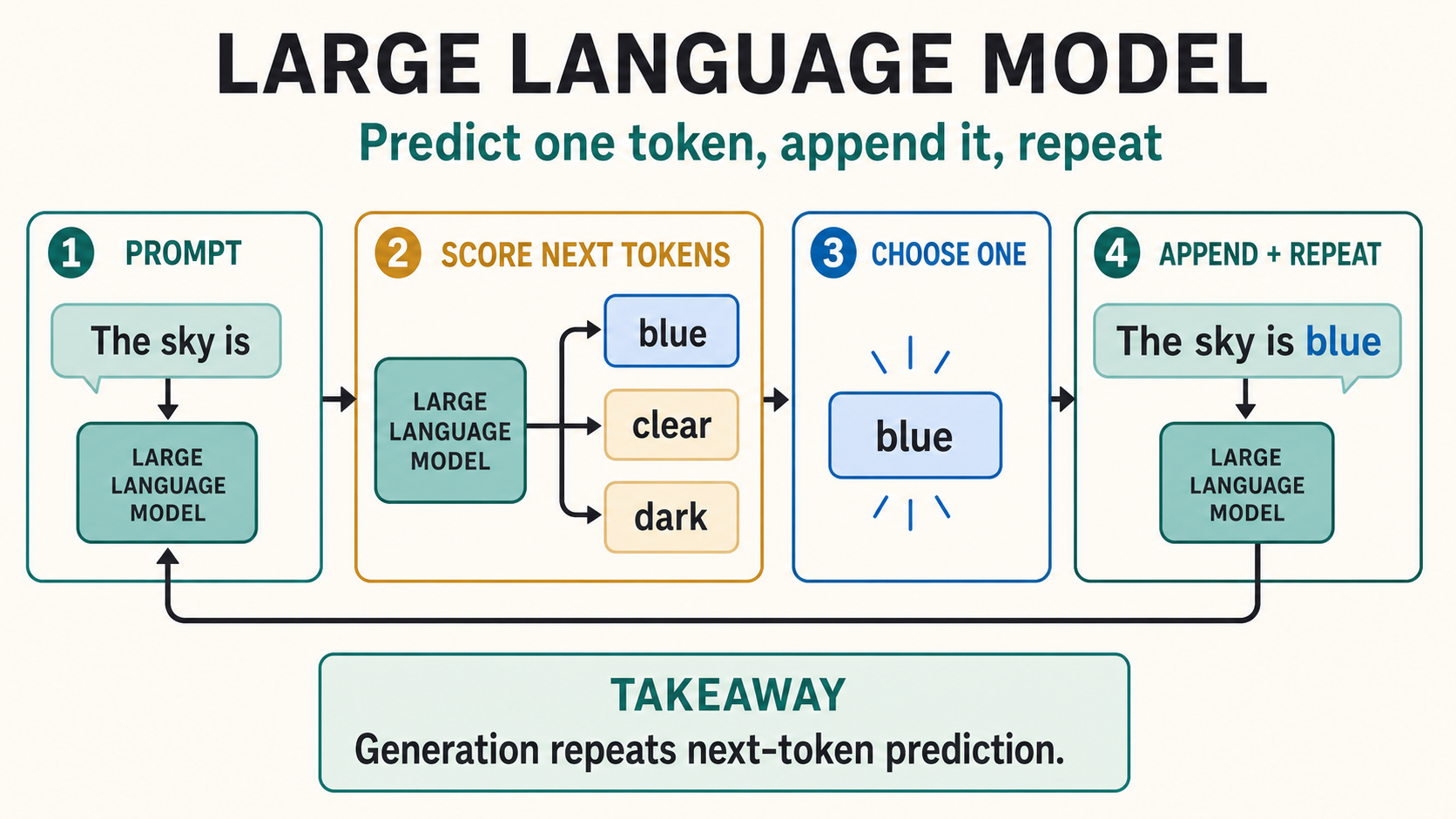
A large language model is a neural network trained on extensive language data to estimate patterns in token sequences, enabling it to generate or represent text for many downstream tasks.
#language models#generative AI#transformersRead entry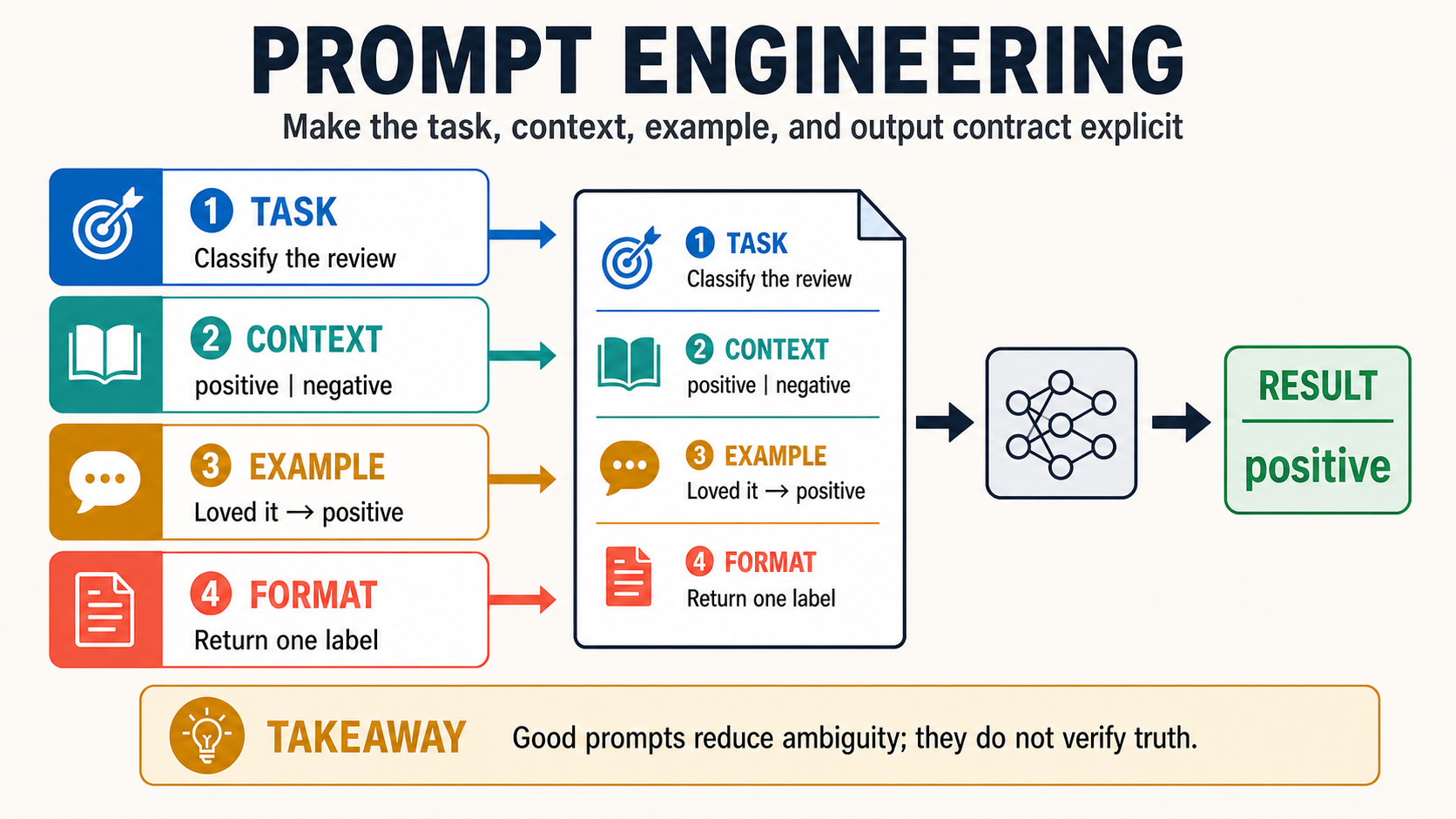
Prompting & Inference
Prompt Engineering: Designing Clear AI Instructions
Prompt engineering is the iterative practice of designing model inputs—such as instructions, context, examples, and output constraints—to improve behavior on a defined task.
#prompting#LLM applications#instructionsRead entry