
Mixture of Experts (MoE): Sparse Model Routing
Also known as: MoE · Sparse Mixture of Experts · Sparsely Gated MoE
Definition
A Mixture of Experts model uses a learned router to send each input, or each token in many transformer implementations, through only a selected subset of expert subnetworks.
Contents
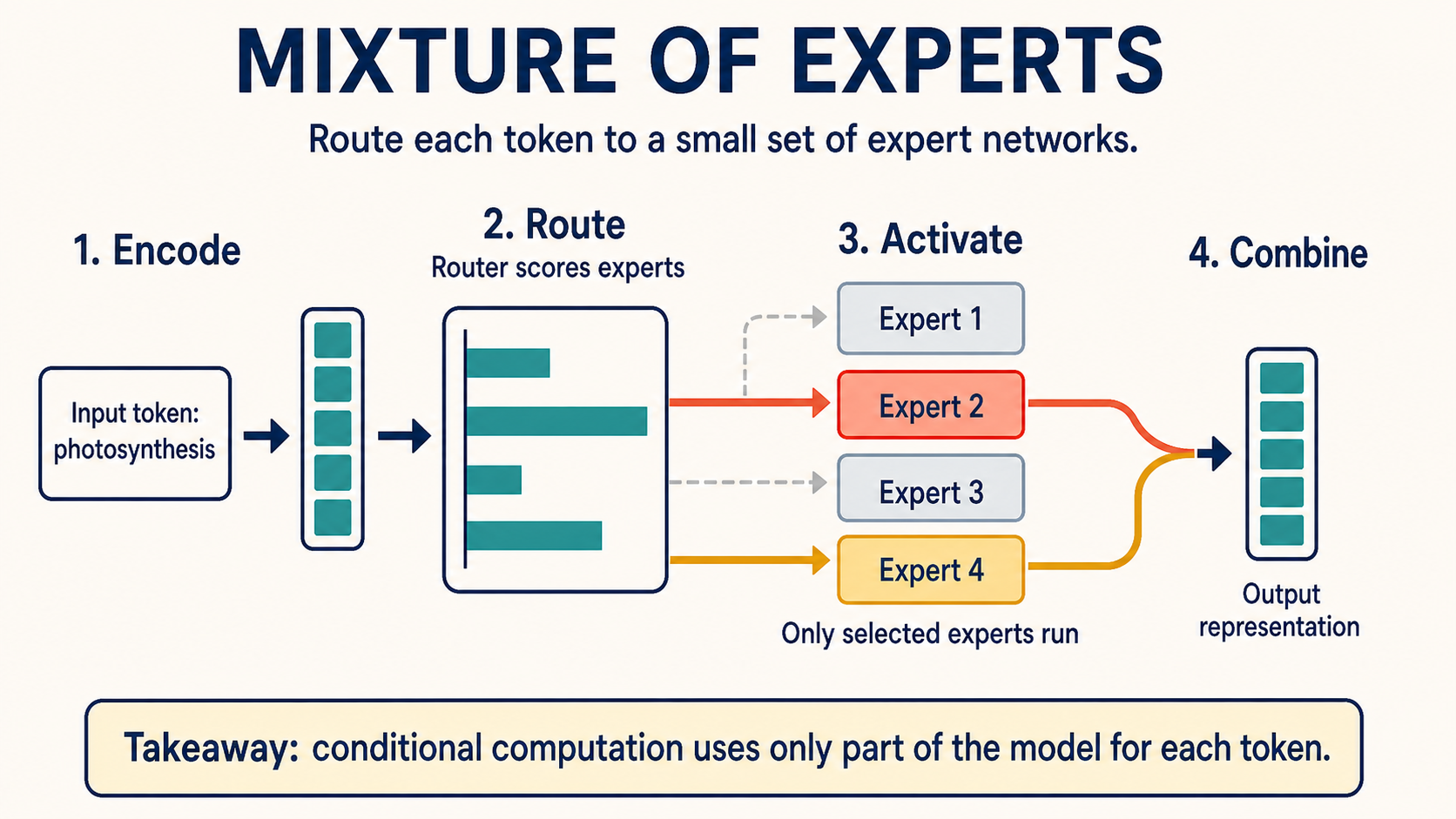
Mixture of Experts (MoE) is a neural-network design based on conditional computation. A model contains several expert subnetworks, but a learned router activates only a small subset for a given input. This separates the model’s total parameter count from the number of parameters used in one computation.
Simple analogy
Imagine a workshop with several equally equipped specialists and a dispatcher. Each incoming job reaches the dispatcher, which chooses a small number of specialists to handle it. The other specialists remain idle for that job, and the selected results are combined before the work continues.
The analogy explains selection and sparsity, but it can also mislead. Neural experts are learned subnetworks, not people with predefined job titles. An expert may develop patterns that do not correspond neatly to categories such as “math” or “science,” and the router itself must be trained.
How it works
A modern transformer MoE commonly replaces some dense feed-forward blocks with MoE layers. The attention layers can remain dense. When a token representation reaches an MoE layer, a small router network produces a score for each available expert.
A routing rule selects the highest-scoring expert or experts. This is often called top-k routing, where k is the number of selected experts. Switch Transformer simplified this pattern to top-1 routing in its design, while other architectures may use two or more experts. MoE is a family of architectures, so no single value of k defines the concept.
Each selected expert processes the token. Experts usually share the same subnetwork shape but have different learned parameters. The layer then combines selected expert outputs using router-derived weights or another architecture-specific rule and passes the resulting token representation onward.
Because only selected experts execute, the layer is sparsely activated. A model can hold many expert parameters while using only a fraction of them for each token. This is conditional computation: the active path depends on the input.
Training requires more than ordinary task loss. Without additional pressure, a router may send too many tokens to a few experts while leaving others underused. Implementations therefore use capacity limits, auxiliary load-balancing objectives, routing noise, or related techniques. If an expert receives more tokens than its capacity allows, some systems drop or reroute excess assignments.
Distributed execution is another important part of large MoE systems. Experts may reside on different accelerators, so token representations must be sent to the devices that host the chosen experts and then returned. GShard studied this combination of conditional computation and automatic sharding at large scale. The communication pattern can become a bottleneck even when arithmetic per token is controlled.
Why it matters
Dense models activate roughly the same parameter set for every token. Increasing a dense model’s parameter count generally increases the compute required for each forward pass. Sparse MoE offers another scaling axis: increase total capacity by adding experts while keeping the active expert count relatively small.
Research such as the sparsely gated MoE layer, GShard, and Switch Transformer showed that this pattern can scale language models and improve training efficiency in particular experimental settings. The benefit is not “free parameters.” Experts still occupy memory and storage, routing must be learned, and distributed communication and training stability require engineering.
MoE also changes how parameter counts should be interpreted. A sparse model and a dense model with the same total parameters may have very different active parameters and inference costs. Meaningful comparison should consider total parameters, active parameters per token, hardware utilization, memory, communication, latency, and measured task quality.
Practical use cases
MoE is used in large language and multimodal model research when developers want to expand model capacity without activating every parameter on every token. It can be especially attractive in large distributed training systems where many accelerators can host different experts.
The architecture can also support multilingual or multi-domain data because routing allows different inputs to follow different computational paths. However, it is unsafe to assume that experts will automatically become clean language or domain modules. Specialization is an empirical property to inspect, not a guaranteed semantic design.
For deployment, batch size and traffic shape matter. An MoE model may have favorable arithmetic estimates yet perform poorly if routing causes uneven device utilization or costly communication. Systems teams therefore profile real latency and throughput rather than relying only on active-parameter counts.
Common misconceptions
MoE is not an ensemble of complete independent models. In a transformer MoE, many layers are shared and expert subnetworks usually occupy selected positions inside one larger model.
Every expert does not run for every token. That would remove the main sparse-computation advantage. The router chooses a subset according to the architecture’s routing rule.
Experts are not guaranteed to have human-readable specialties. Researchers may observe patterns, but labels such as “coding expert” can be an oversimplification unless supported by careful analysis.
More total parameters do not automatically mean better quality. Routing, data, optimization, expert capacity, and hardware execution all affect results. Poor routing can waste experts or overload a small subset.
Sparse does not mean small. An MoE checkpoint may require substantial memory even when each token activates relatively few parameters. The model must still store or distribute all expert weights.
MoE is best understood as a routing architecture that exchanges dense activation for conditional paths. It expands potential capacity while introducing new optimization, memory, and systems tradeoffs.
Frequently asked questions
What does the router do in a Mixture of Experts model?
It scores available experts for an input representation and selects the expert subset that will process it, often using a top-k rule.
Does each MoE expert represent a topic such as math or code?
Not necessarily. Experts are learned subnetworks and may specialize in patterns that are distributed, overlapping, or difficult to describe with human topic labels.
Why can MoE have many parameters without using all of them per token?
The model stores many expert subnetworks, but conditional routing activates only selected experts for each token. Total parameters and active parameters are therefore different quantities.
What are the main MoE tradeoffs?
Key tradeoffs include router stability, load balancing, expert capacity, memory for all expert weights, and communication between devices that host different experts.
Related concepts
Models & Architecture
Transformer: The Architecture Behind Modern AI
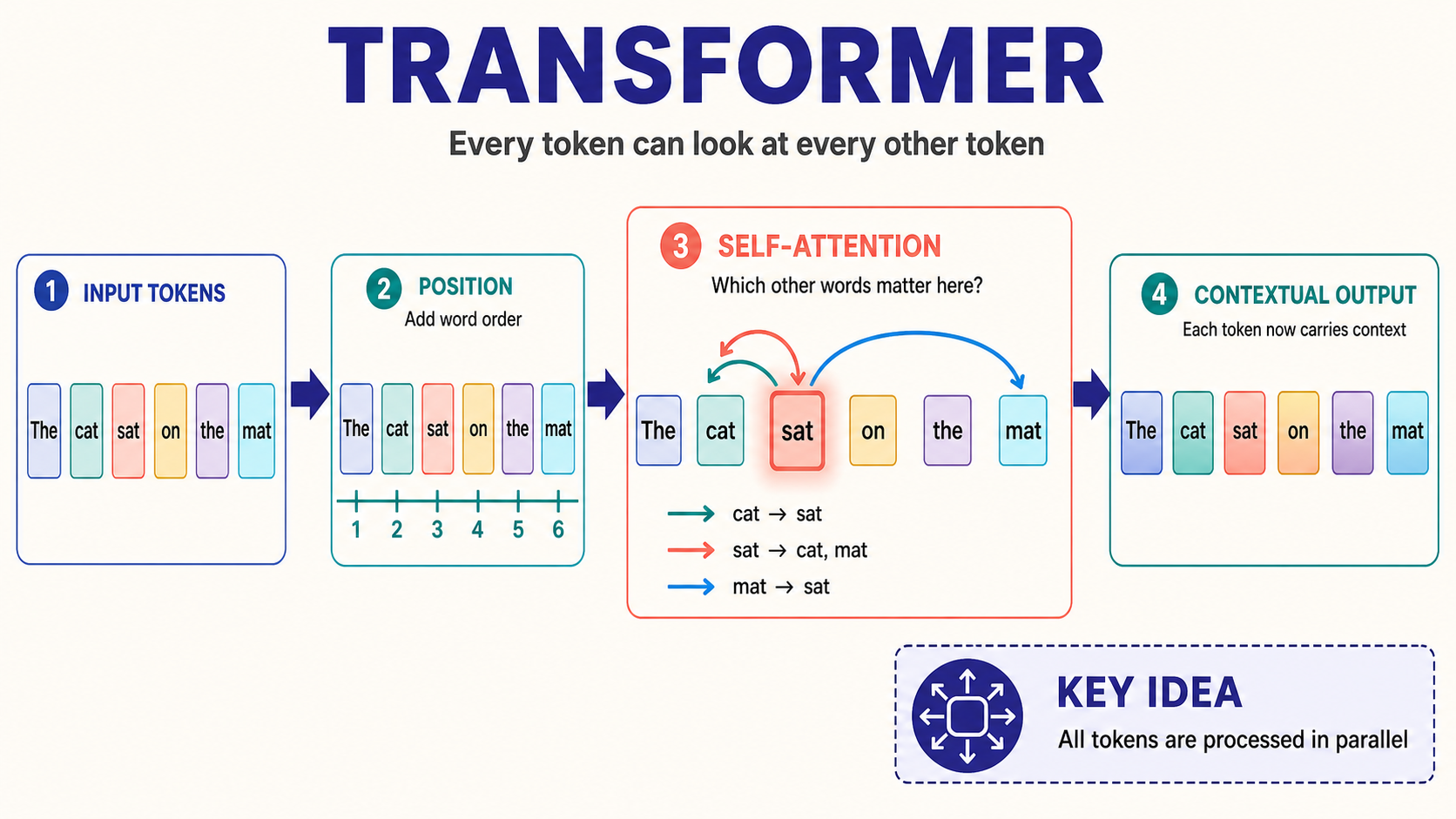
A Transformer is a neural-network architecture that uses attention to build context-aware representations of tokens, allowing many sequence positions to be processed in parallel.
#neural networks#attention#model architectureRead entry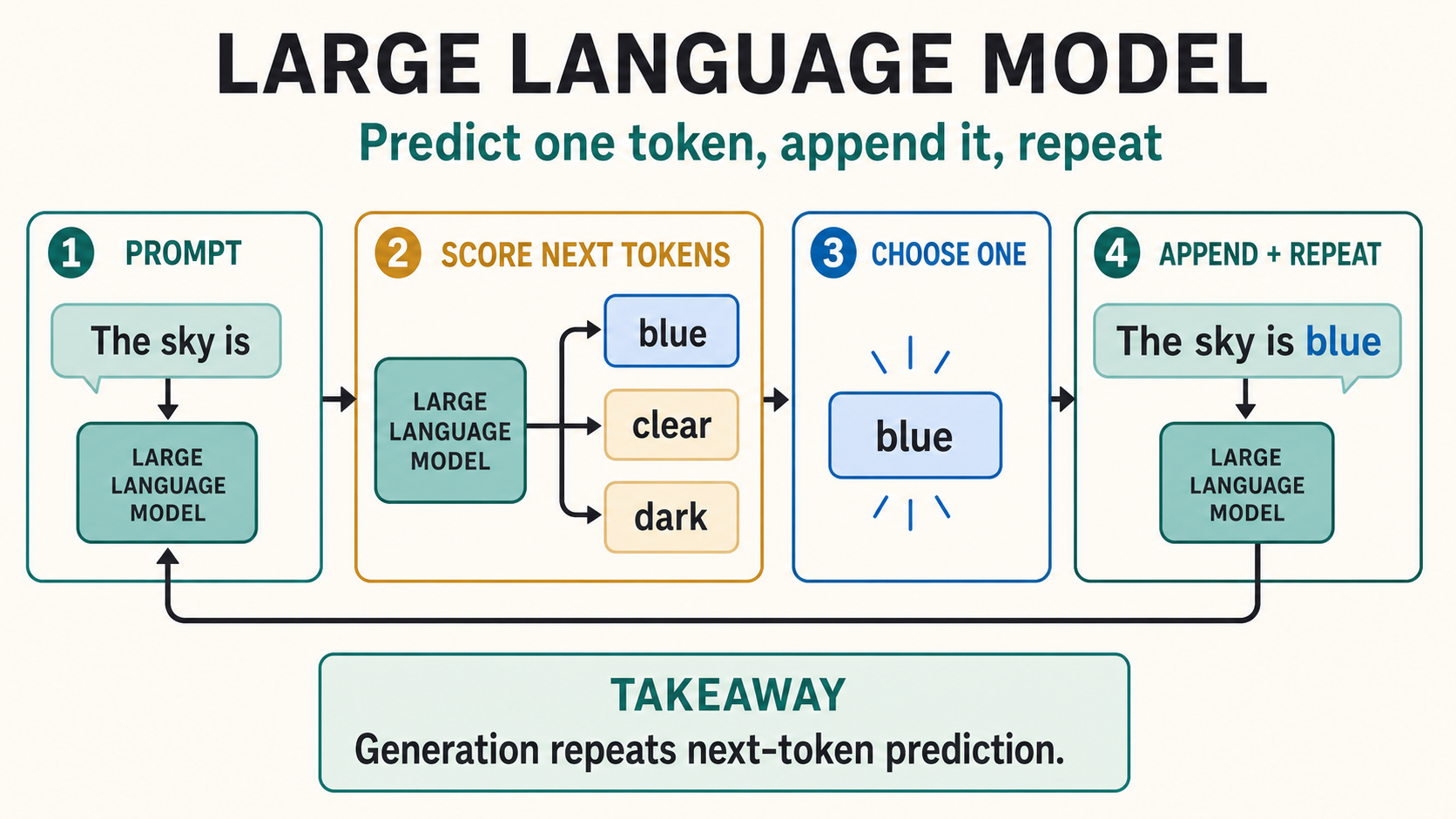
Models & Architecture
Large Language Models (LLMs): How They Generate Text
A large language model is a neural network trained on extensive language data to estimate patterns in token sequences, enabling it to generate or represent text for many downstream tasks.
#language models#generative AI#transformersRead entry