
Model Quantization: Using Fewer Bits for AI Models
Also known as: Neural network quantization · Low-bit quantization · LLM quantization
Definition
Model quantization represents some neural-network values, such as weights or activations, with lower-precision numeric formats so the model can use less memory and potentially run more efficiently on compatible hardware.
Contents
Model quantization reduces the numeric precision used to represent some values in a neural network. A model trained or stored with high-precision floating-point values may be converted so that weights, activations, or both use fewer bits. Fewer bits can reduce checkpoint size and memory traffic, and compatible hardware may execute the resulting operations more efficiently.
Quantization is an approximation. Many original values are mapped to a smaller set of representable levels. Good methods choose those levels and apply them in ways that keep task quality within an acceptable range. The result depends on the model, data, bit width, quantization scheme, software kernel, and hardware.
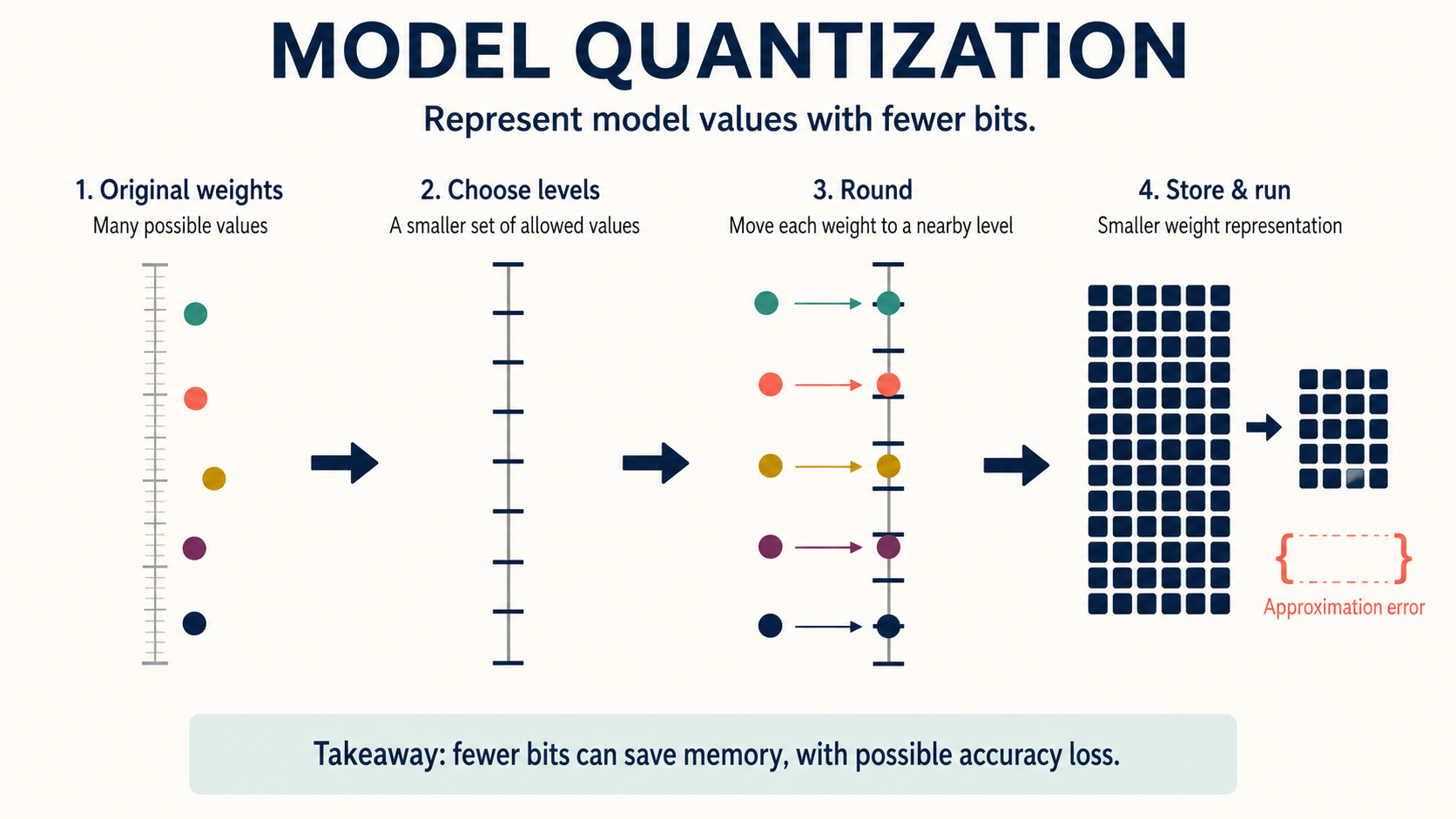
Simple analogy
Imagine recording temperature with a ruler. A fine ruler has many marks, so it can record 21.37 degrees closely. A coarse ruler may allow only a smaller set of readings, so the same temperature is rounded to a nearby mark. The coarse record takes less detail to store, but it introduces a small difference from the original.
A neural network contains many numeric values rather than one temperature. Small rounding errors may have little effect in one part of the model and a large effect in another. Quantization methods therefore differ in how they set ranges, group values, preserve sensitive components, and calibrate the conversion.
How it works
A common uniform quantization scheme chooses a scale that maps a real-valued range to a finite set of integer levels. Each original value is divided by the scale, rounded to an allowed integer, and stored in the low-precision format. During computation, the system either operates directly on those integers with associated scales or reconstructs approximate values as needed. Some schemes also use a zero point so an integer level corresponds exactly to real zero.
The scale can cover an entire tensor, a channel, or a smaller group of values. Per-tensor quantization uses one scale for a large array and is simple, but a few extreme values can force a wide range. Per-channel or group-wise quantization uses multiple scales, which can fit local value distributions more closely at the cost of extra metadata and implementation complexity.
Weight-only quantization lowers the precision of stored model weights while activations use a higher-precision format. This can substantially reduce weight memory, which matters when moving parameters from memory is a bottleneck. Weight-and-activation quantization can enable lower-precision matrix operations but must also handle input-dependent activation ranges.
In post-training quantization, a pretrained model is converted without repeating its original full training. A calibration set may be used to observe activation ranges or estimate which weights are sensitive. GPTQ is a post-training method designed to quantize transformer weights while accounting for the effect of quantization error. AWQ uses observed activations to identify salient weights and choose a weight-quantization strategy intended to preserve them.
In quantization-aware training, the model is trained or fine-tuned while simulating low-precision effects. This can help parameters adapt to rounding, although it requires training data, compute, and a suitable implementation. The boundary between methods is broad: some workflows optimize scales or small auxiliary parameters without performing a full retraining run.
Outliers are important in large language models. LLM.int8() observed that some transformer features can have unusually large magnitudes and proposed handling those dimensions separately while computing most operations at lower precision. Other approaches use clipping, mixed precision, reordering, or fine-grained groups. There is no single quantization recipe that is best for every model.
Why it matters
Large models can be limited by memory capacity and memory bandwidth. Reducing the bits per stored weight can make a checkpoint smaller and may allow a model to fit on fewer or less expensive devices. Smaller transfers from memory can also improve throughput or latency when the execution path is memory-bound.
However, a compact file does not guarantee a faster application. Real speed depends on whether the runtime has optimized kernels for the exact format, whether values must be converted during execution, batch size, sequence length, caching, and the target device. A nominally low-bit model can be slower than a higher-precision model if the software path is poorly supported.
Quantization also changes deployment choices. An organization may trade a small measured quality reduction for lower memory use, higher request capacity, or on-device execution. That decision should be based on application-specific tests rather than a generic claim that one bit width is always sufficient.
Practical use cases
Local language-model applications use weight quantization to fit models into desktop or mobile memory. Server deployments use it to host more replicas per accelerator or reduce the hardware required for a given model, subject to supported kernels and latency tests.
Edge vision, speech, and sensor models often use integer quantization on processors designed for low-precision operations. In those cases, the deployment toolchain may impose specific operator and format requirements that influence how the model is trained or converted.
Researchers can use quantized checkpoints to make evaluation and experimentation accessible on smaller hardware. Results obtained from the quantized version should be labeled clearly because its behavior may not match the original checkpoint on every task.
A sound evaluation compares model quality, peak memory, checkpoint size, latency, throughput, energy use if relevant, and operational stability. It should include difficult examples and long contexts, not only an average benchmark score. Safety classifiers, structured output, rare languages, and numerical tasks may respond differently to approximation.
Common misconceptions
Quantization is not ordinary file compression. It changes the numeric representation used by the model and can change outputs. A general-purpose compressed archive becomes exact again when decompressed; quantization is usually lossy.
A lower bit width does not guarantee a fixed memory reduction. Scales, zero points, higher-precision layers, runtime buffers, activation memory, and key-value caches all contribute to total memory use.
Low-bit does not automatically mean faster. The hardware and runtime must support efficient kernels for the selected format. Conversion overhead or unsupported operations can remove the expected benefit.
All weights are not equally sensitive. Outliers and important channels can dominate error, so many methods use mixed precision, groups, calibration, or special handling rather than applying one global rule.
Benchmark similarity is not universal equivalence. Two versions can score similarly on one dataset and diverge on another task or prompt distribution. Deployment evaluation must reflect the actual application.
Model quantization is best understood as a measured systems tradeoff: it exchanges numeric precision for a potentially smaller and more efficient representation while requiring evidence that quality remains acceptable.
Frequently asked questions
What parts of a neural network can be quantized?
Methods may quantize weights, activations, or both. Some layers or sensitive values can remain at higher precision in a mixed-precision design.
What is post-training quantization?
It converts an already trained model to a lower-precision representation, often using calibration data or optimization to limit the resulting error.
Does a 4-bit model always use one quarter of the memory of a 16-bit model?
No. Quantization metadata, higher-precision components, runtime buffers, activations, and caches mean total application memory does not follow a single fixed ratio.
How should a quantized model be evaluated?
Test application quality and failure cases together with checkpoint size, peak memory, latency, throughput, and the exact runtime and hardware used in production.
Related concepts
Models & Architecture
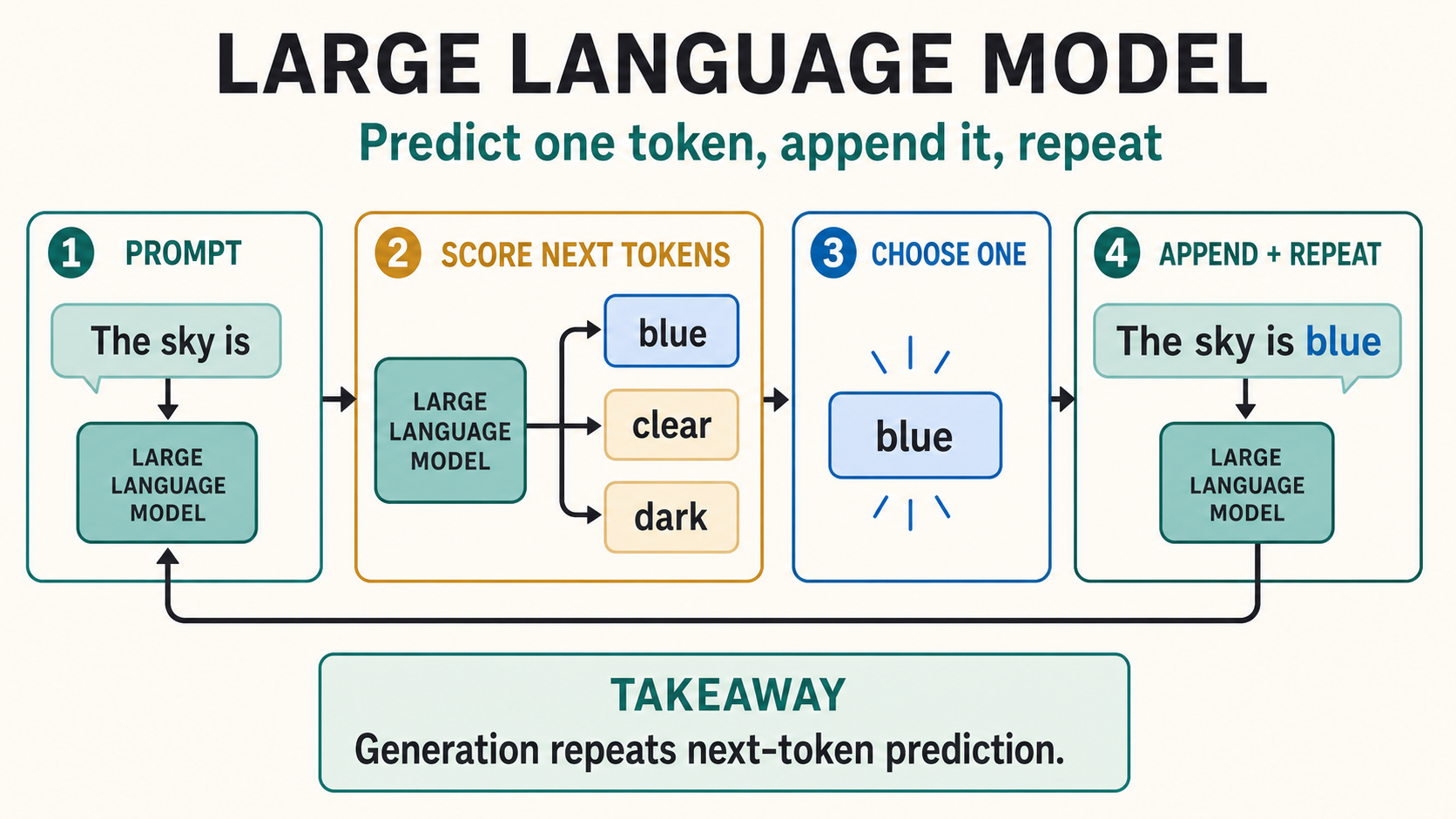
Large Language Models (LLMs): How They Generate Text
A large language model is a neural network trained on extensive language data to estimate patterns in token sequences, enabling it to generate or represent text for many downstream tasks.
#language models#generative AI#transformersRead entry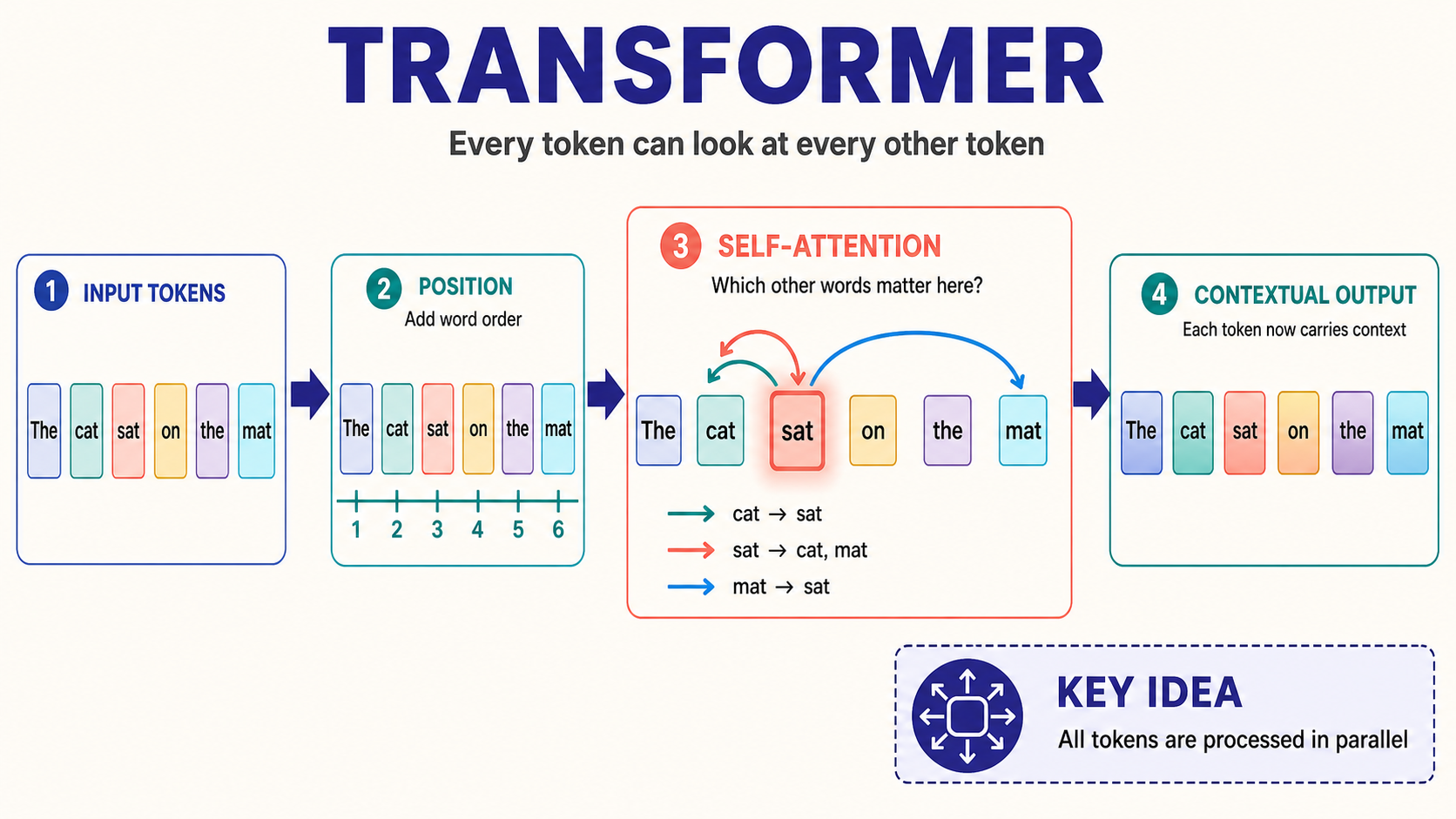
Models & Architecture
Transformer: The Architecture Behind Modern AI
A Transformer is a neural-network architecture that uses attention to build context-aware representations of tokens, allowing many sequence positions to be processed in parallel.
#neural networks#attention#model architectureRead entry