
AI Hallucination: Fluent but Unsupported Output
Also known as: LLM Hallucination · Model Hallucination · Confabulation
Definition
An AI hallucination, also called a confabulation, is generated content that is false, unsupported, internally inconsistent, or inconsistent with the provided input while often sounding plausible.
Contents
An AI hallucination is an output that appears coherent but is false, unsupported, internally inconsistent, or disconnected from the supplied evidence. NIST uses the term confabulation for this risk and notes that generated explanations or citations can also be fabricated.
Simple analogy
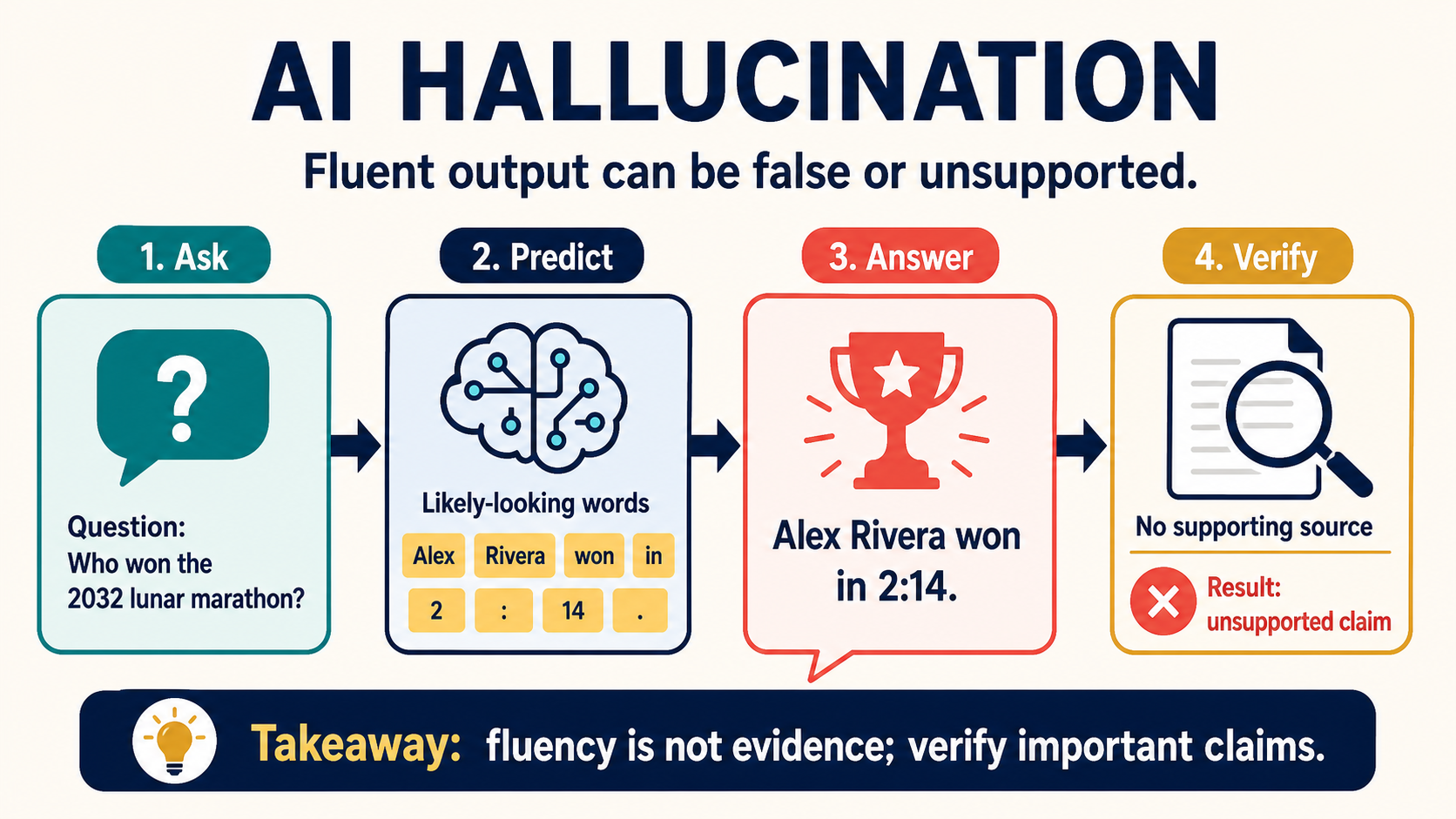
Imagine an autocomplete system asked about a future event. Instead of saying that the answer is unavailable, it continues with a name and time that look like a familiar sports result. The sentence is grammatically smooth because each piece fits common language patterns, but no evidence supports the claim.
That is the central danger: fluency and factual grounding are different properties. A generated sentence can look exactly like a reliable answer while lacking a valid connection to the world, the input, or a source.
How it works
A generative language model predicts a distribution over possible next tokens from the context it receives. Training rewards the model for producing continuations that match patterns in its data. This objective can produce accurate and useful language, but it is not itself a fact-checking procedure.
When the prompt asks for missing, ambiguous, conflicting, or obscure information, the model may still generate a plausible continuation. The parameters encode statistical regularities rather than a traceable record for every claim. Decoding then selects tokens from those predicted distributions. A sequence of locally plausible choices can become a specific but unsupported statement.
Hallucination can take several forms. An output may contradict the source text, add a detail that the source never provided, invent a citation, attribute a statement to the wrong person, or remain internally consistent while being false in the external world. In summarization research, intrinsic hallucination often means contradiction of the source, while extrinsic hallucination means adding unverifiable information. Terminology varies by task, so evaluations should define the error being measured.
The prompt and surrounding system matter. Long or distracting context can make relevant evidence harder to use. Retrieval can return irrelevant, stale, or contradictory documents. A tool can fail or provide malformed data. A model may also follow an incorrect premise embedded in a user question. Hallucination is therefore a system-level concern, not only a property of the base model.
Verification requires checking claims against appropriate evidence. For a current factual answer, that may mean authoritative documents or a trusted database. For a calculation, it may mean a deterministic tool. For a summary, it means comparing every substantive claim with the source. Self-consistency or asking the same model to “double-check” can reveal some problems, but agreement between generated answers is not independent evidence.
Why it matters
Hallucinations can turn a helpful language interface into a source of misinformation. The risk is especially high when an answer includes confident detail, fabricated citations, or a polished chain of reasoning that encourages users to trust it.
Impact depends on context. A fictional detail in brainstorming may be harmless or desired. The same behavior in medicine, law, finance, security, or public information can cause serious harm. Risk management should therefore consider both the probability of an unsupported output and the consequence of someone acting on it.
Hallucination also complicates automation. A human may notice an absurd statement, while software can pass a fluent answer directly into a database, report, email, or downstream tool. Structured output validation can confirm shape, but a valid JSON object can still contain false facts.
Practical use cases
Question-answering systems can use retrieval-augmented generation to provide relevant source material at inference time. The generated answer should preserve links or citations so a user can inspect the evidence. Retrieval improves access to external knowledge but does not guarantee faithfulness; the retriever, source quality, and answer grounding all need evaluation.
Applications can route deterministic tasks to tools. A calculator is more reliable for arithmetic, and a current inventory database is more appropriate for stock counts. Systems can require abstention when evidence is missing, constrain answers to supplied documents, or escalate uncertain high-impact cases to a qualified reviewer.
Evaluation should use representative tasks and score factuality or faithfulness directly. Adversarial cases, unanswerable questions, misleading premises, and citation checks are important because ordinary accuracy tests may not expose confident invention. Monitoring after deployment is necessary as user behavior, data, and connected tools change.
Common misconceptions
Hallucination is not deliberate lying. A model does not need intent or awareness to generate an unsupported statement. The error arises from the generation process and system conditions.
A confident tone does not indicate high confidence in a calibrated statistical sense. Style can remain assertive even when evidence is absent. Users should not infer certainty from wording alone.
Retrieval does not eliminate hallucinations. It can ground answers in external evidence, but models may ignore, distort, or overextend that evidence, and retrieval may return poor sources.
Lower randomness does not guarantee truth. Decoding settings can affect variation, but the highest-probability continuation can still be wrong or unsupported.
Citations are not proof unless they are checked. A citation may be fabricated, irrelevant, or inconsistent with the claim. Reliable systems verify that the source exists and materially supports the statement.
The practical goal is not to assume hallucinations can be completely removed. It is to design evidence paths, evaluations, abstention behavior, interfaces, and human oversight that make unsupported claims less likely and less harmful.
Frequently asked questions
Why do language models hallucinate?
They generate likely token sequences from learned patterns rather than running an inherent fact-check for every statement. Missing evidence, ambiguous prompts, retrieval failures, and decoding choices can all contribute.
Is an AI hallucination the same as a lie?
No. Lying implies intent to deceive. Hallucination describes an unsupported or false generated output without requiring intent, awareness, or a model belief.
Can retrieval-augmented generation prevent hallucinations?
It can reduce some knowledge-grounding errors by supplying external evidence, but it cannot guarantee correctness. Retrieval quality and answer faithfulness still need testing and verification.
How should important AI claims be verified?
Check them against authoritative, current sources or deterministic tools appropriate to the task. Confirm that cited material exists and directly supports each consequential claim.
Related concepts
Models & Architecture
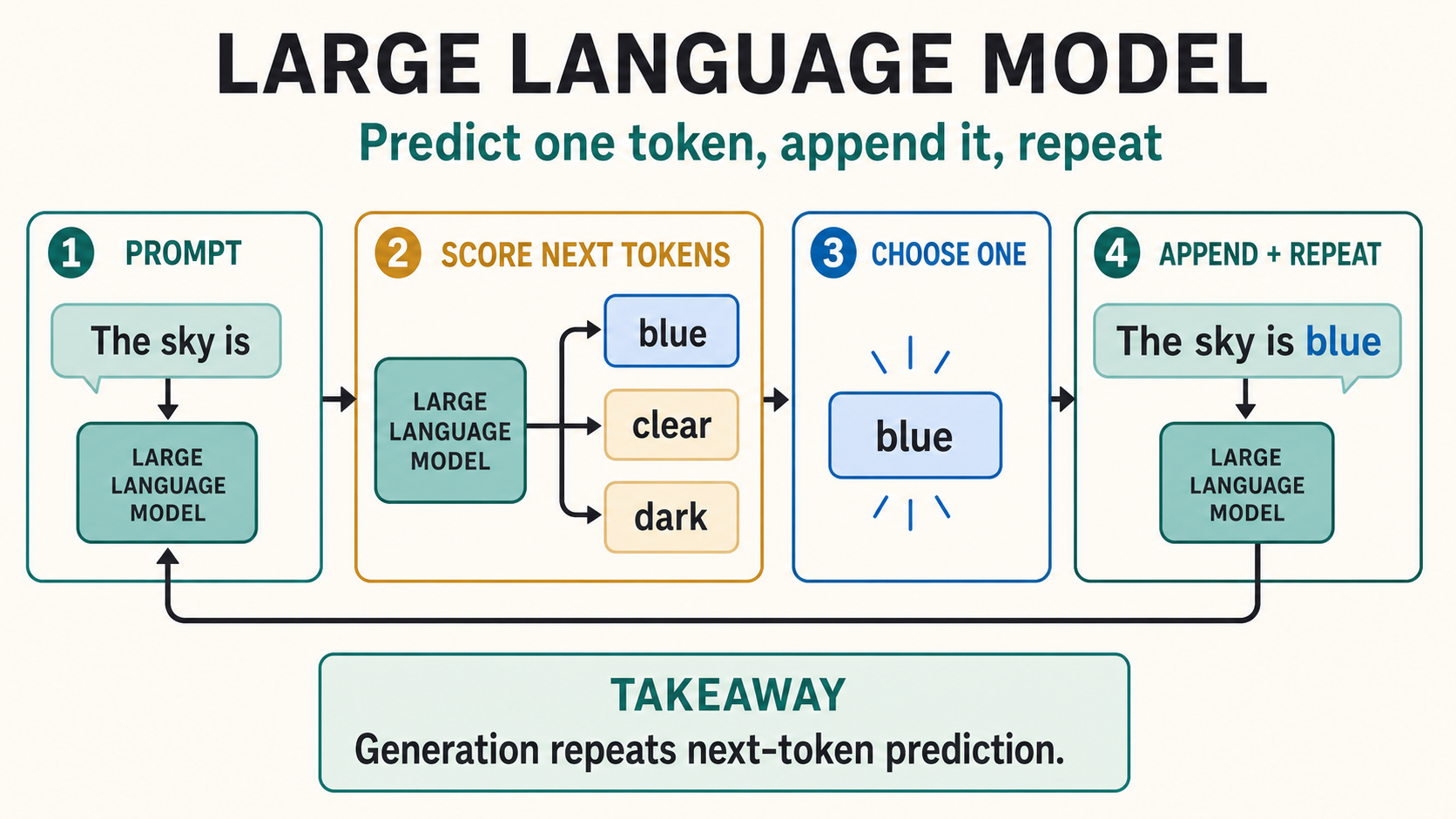
Large Language Models (LLMs): How They Generate Text
A large language model is a neural network trained on extensive language data to estimate patterns in token sequences, enabling it to generate or represent text for many downstream tasks.
#language models#generative AI#transformersRead entry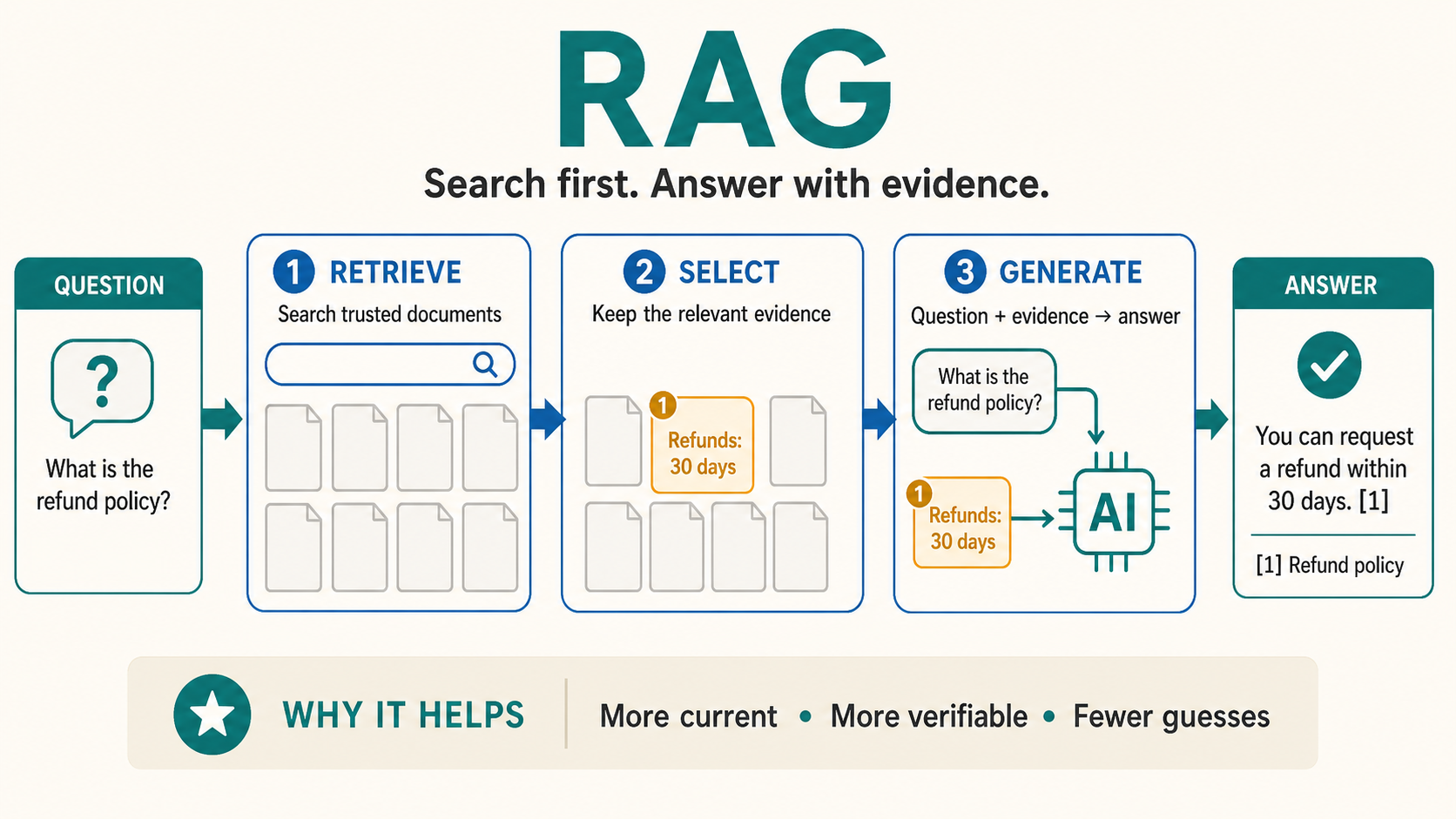
Knowledge & Tuning
Retrieval-Augmented Generation (RAG) Explained
Retrieval-Augmented Generation is a method that retrieves relevant external information for a query and supplies it to a generative model as context before the model produces an answer.
#RAG#retrieval#LLM applicationsRead entry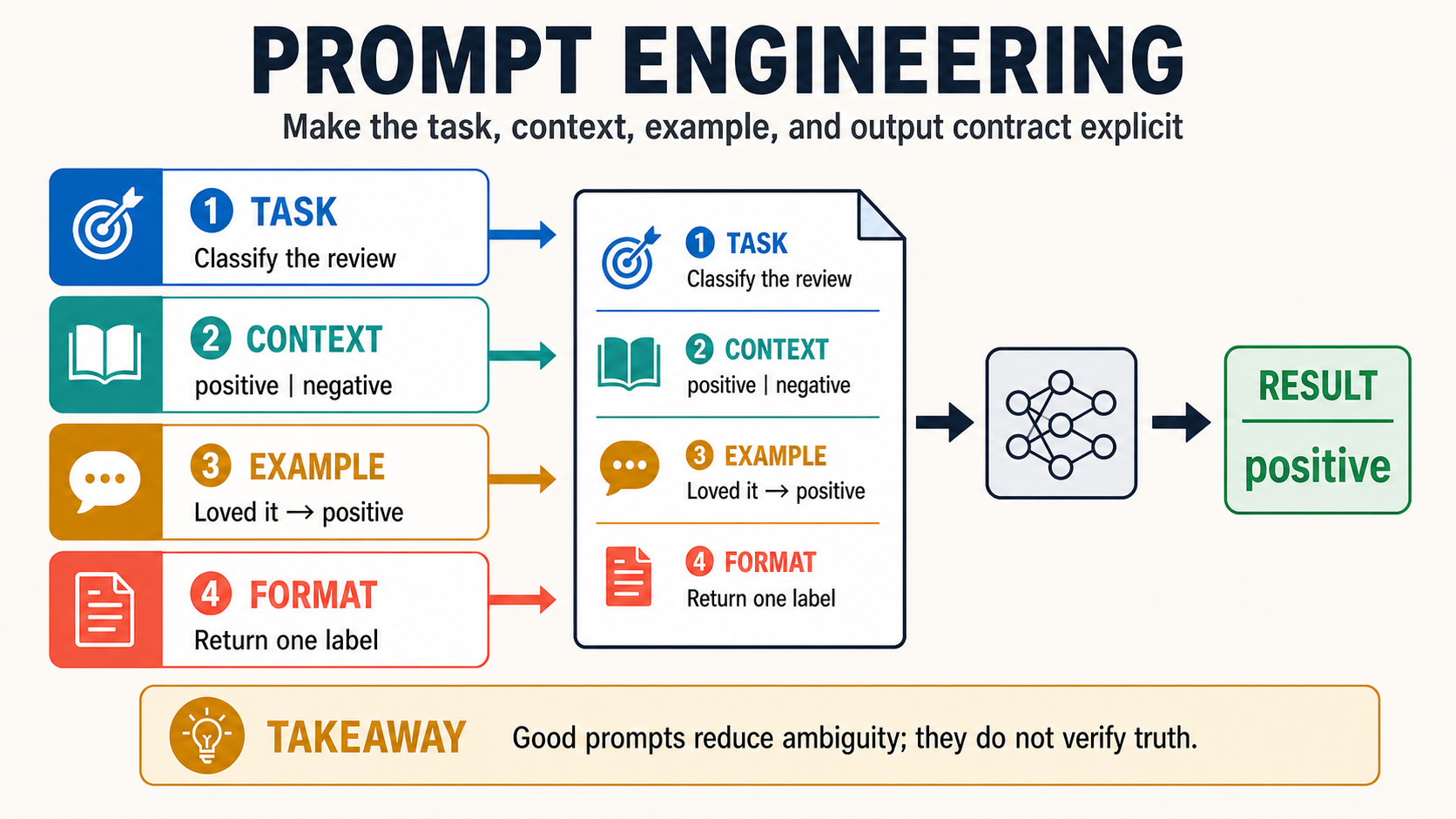
Prompting & Inference
Prompt Engineering: Designing Clear AI Instructions
Prompt engineering is the iterative practice of designing model inputs—such as instructions, context, examples, and output constraints—to improve behavior on a defined task.
#prompting#LLM applications#instructionsRead entry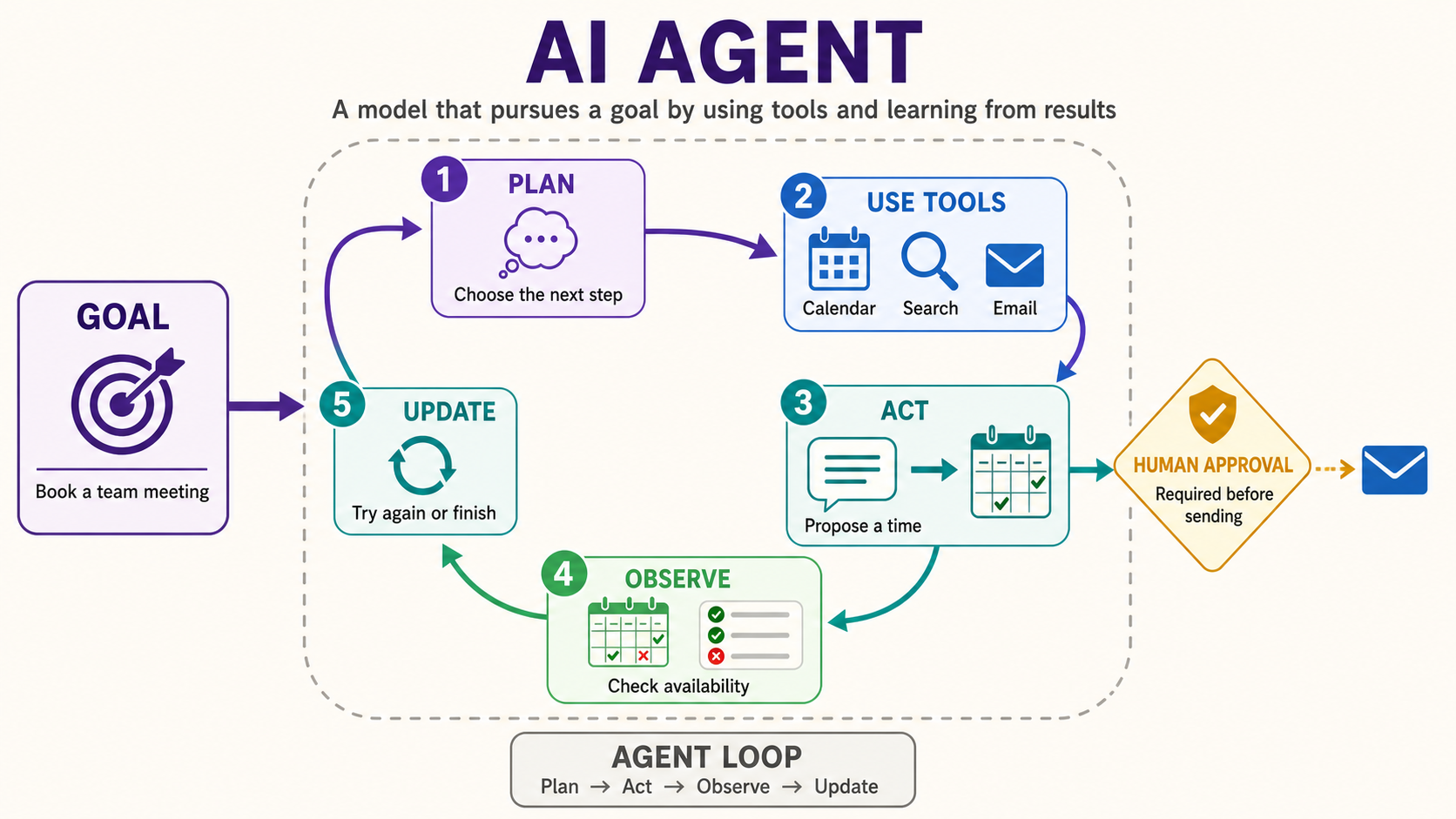
Agents & Ecosystem
AI Agent: Goals, Tools, Feedback, and Guardrails
An AI agent is a system that uses a model to interpret a goal, choose actions, interact with tools or an environment, observe results, and adapt within defined limits.
#AI agents#tool use#automationRead entry