
RLHF: Reinforcement Learning from Human Feedback
Also known as: RLHF · Human preference reinforcement learning · Learning from human preferences
Definition
Reinforcement learning from human feedback is a family of post-training methods that uses human preference judgments to construct a reward signal and optimize a model's behavior toward those measured preferences.
Contents
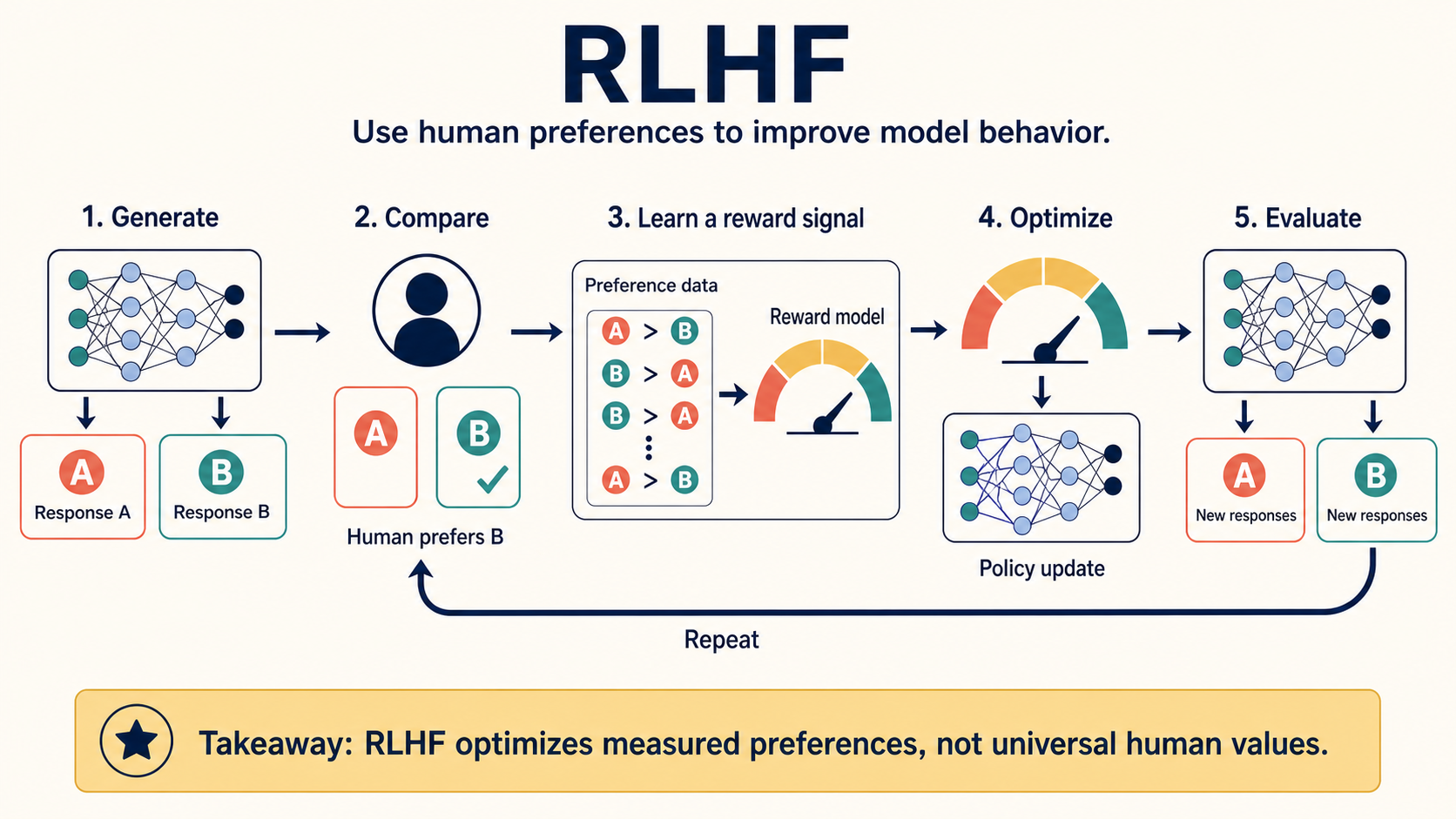
Reinforcement learning from human feedback, usually shortened to RLHF, is a post-training approach for shaping model behavior with human judgments. Instead of requiring people to write the perfect response for every prompt, a common workflow asks them to compare model outputs. Those preferences are used to learn a reward signal, and reinforcement learning then updates the model to receive higher predicted reward.
RLHF is a family of methods rather than one fixed recipe. The data collection interface, reward model, optimization algorithm, regularization, and evaluation process can differ. The central idea is to turn limited human comparisons into a signal that can guide many model updates.
Simple analogy
Imagine coaching a musician by comparing pairs of performances. The coach may find performance B clearer than performance A without writing a complete ideal performance. After many comparisons, a training system estimates which characteristics the coach tends to prefer. The musician practices toward that estimated signal and is evaluated again.
The estimate is useful but incomplete. It reflects the examples, questions, annotators, and comparison rules used to create it. The musician could learn superficial tricks that score well without improving the deeper quality the coach intended. RLHF has the same distinction between measured reward and the broader behavior people actually want.
How it works
For language models, the process often begins with a pretrained model and supervised fine-tuning on demonstrations of desired responses. This produces a policy that can follow instructions more reliably than the raw pretrained model and generates candidate answers suitable for preference comparison. Supervised fine-tuning is commonly part of an RLHF pipeline, although the exact starting point varies.
Next, the system presents human annotators with two or more responses to the same prompt. Annotators rank them according to written criteria such as helpfulness, relevance, correctness, or safety. The result is preference data. For a given prompt, one response was preferred over another. Quality controls may include training examples, agreement checks, adjudication, and audits across annotator groups.
A reward model is then trained on those comparisons. It receives a prompt and response and predicts a scalar score intended to match the observed ordering. If response B was preferred to response A, training encourages the reward model to score B higher. The learned model can score many new responses more cheaply than asking a person for every comparison.
The language-model policy is optimized against that learned reward. In influential language-model work, Proximal Policy Optimization, or PPO, was used to increase predicted reward while a penalty discouraged the updated policy from moving too far from a reference model. This constraint helps limit unstable changes and exploitation of reward-model weaknesses. PPO is historically important, but not every human-feedback system uses it or the same objective.
After optimization, researchers evaluate fresh outputs with people and automated tests. New failure cases can lead to revised instructions, additional preference data, a new reward model, or another policy update. The loop matters because the policy changes the distribution of responses the reward model sees.
The process contains at least three different learned objects or datasets that should not be conflated: the language-model policy, the human preference dataset, and the reward model that approximates those preferences. A high reward-model score is a prediction, not a direct human judgment and not proof that the response is correct.
Why it matters
Many qualities people want from an assistant are difficult to specify with a simple programmatic metric. There is no universal formula for whether an explanation is appropriately detailed, whether a refusal is proportionate, or whether a summary preserves the most important information. Pairwise human comparisons provide one practical way to collect signals about such qualities.
Research on learning from human preferences showed that comparisons could guide reinforcement learning in tasks where a hand-written reward was difficult. Later work applied the approach to text summarization and instruction following. In those studies, human-feedback training improved measured preferences relative to selected baselines under the tested conditions.
RLHF also illustrates a central alignment problem: optimizing a proxy is not the same as satisfying the underlying intent. Annotators have limited time and context. Guidelines can omit important values. The reward model generalizes imperfectly. The policy may discover outputs that exploit those imperfections, a behavior often described as reward hacking or overoptimization.
The method therefore matters both as an effective engineering technique and as a source of new evaluation questions. Teams must ask whose preferences are represented, how disagreements are handled, what happens outside the training distribution, and whether measured gains persist under adversarial or high-stakes testing.
Practical use cases
Instruction-following assistants use human preference data to shape tone, relevance, refusal behavior, and adherence to requested formats. Summarization systems can be optimized toward summaries that reviewers prefer, while factuality and coverage are evaluated separately with targeted tests.
Domain-specific assistants can collect comparisons from qualified reviewers. A legal or medical domain requires expert criteria and strong safeguards; preference optimization does not make generated advice automatically reliable. Sensitive deployments still need source grounding, uncertainty communication, human oversight, and task-specific validation.
RLHF can also be used to tune narrower policies, such as choosing a helpful response style or reducing a recurring undesirable behavior. Before training, teams should define comparison rubrics, annotate ambiguous examples, measure inter-rater agreement, and retain a held-out evaluation set.
Operational monitoring should look beyond average preference win rates. Useful measures include factual accuracy, calibration, subgroup behavior, refusal quality, robustness to prompt attacks, regression on core capabilities, and how performance changes for prompts unlike the training data.
Common misconceptions
Human feedback is not a single objective truth. Preferences vary among people, cultures, contexts, and annotation guidelines. A dataset represents a sampling and aggregation process, not universal human values.
The reward model is not the same as a human evaluator. It is a learned predictor that can be wrong, especially on responses different from its training examples. The policy may exploit those errors.
RLHF does not guarantee factual accuracy or safety. Annotators may prefer a confident answer that contains an unnoticed error. Factuality, security, and high-stakes behavior require dedicated evaluation and controls.
RLHF is not simply supervised fine-tuning. Supervised demonstrations may initialize the policy, but the distinctive loop uses preference-derived reward and policy optimization. Real systems often combine several post-training methods.
RLHF does not always mean PPO. PPO was used in prominent implementations, but RLHF describes the broader use of reinforcement learning with a reward derived from human feedback. Algorithms and constraints can differ.
A higher reward score is not sufficient evidence of improvement. The score can rise while real human preference plateaus or degrades. Fresh human evaluation and independent metrics are necessary.
RLHF is best understood as structured optimization against measured human preferences. It can make behavior more useful under a chosen evaluation process, but its limits are defined by the feedback, reward model, optimization, and tests that surround it.
Frequently asked questions
What kind of human feedback is commonly used in RLHF?
A common format is pairwise or ranked comparison of several model responses to the same prompt, guided by written evaluation criteria.
What does the reward model do?
It predicts a scalar score for a prompt and response that is trained to reproduce observed human preference orderings on the comparison dataset.
Why can optimizing the reward model cause problems?
The reward model is an imperfect proxy. A policy can find outputs that receive high predicted reward while failing to satisfy the deeper intent behind the feedback.
Does every RLHF system use PPO?
No. PPO is an influential reinforcement-learning algorithm used in prominent language-model work, but RLHF pipelines can use different optimization methods and constraints.
How should an RLHF-trained model be evaluated?
Use fresh human comparisons and independent tests for factuality, safety, robustness, subgroup behavior, capability regressions, and prompts outside the training distribution.
Related concepts
Models & Architecture
Fine-Tuning: Adapting a Pretrained AI Model
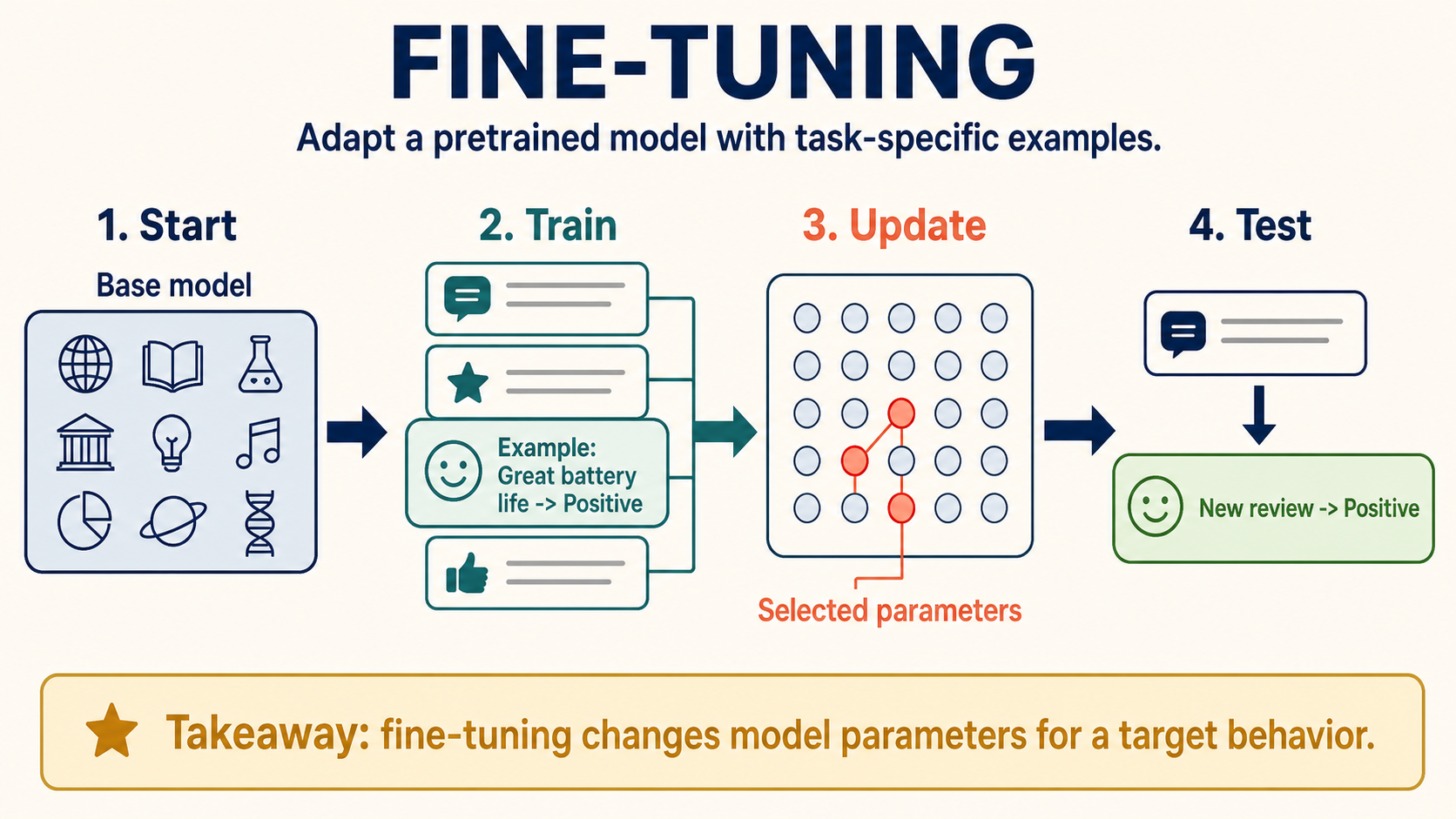
Fine-tuning continues training a pretrained model on a more focused dataset so that some or all of its parameters adapt to a target task, domain, or behavior.
#model adaptation#training#LLM applicationsRead entry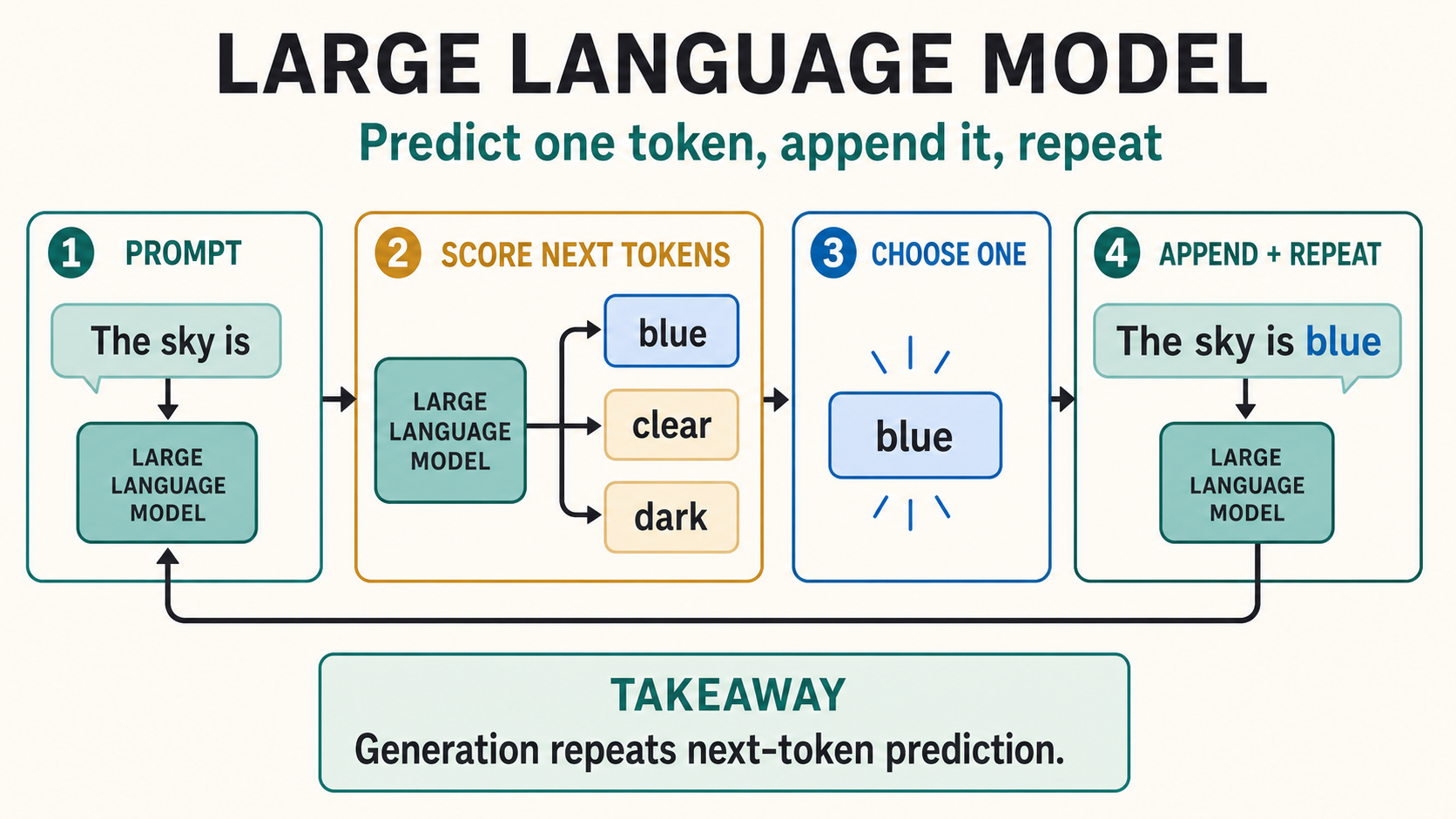
Models & Architecture
Large Language Models (LLMs): How They Generate Text
A large language model is a neural network trained on extensive language data to estimate patterns in token sequences, enabling it to generate or represent text for many downstream tasks.
#language models#generative AI#transformersRead entry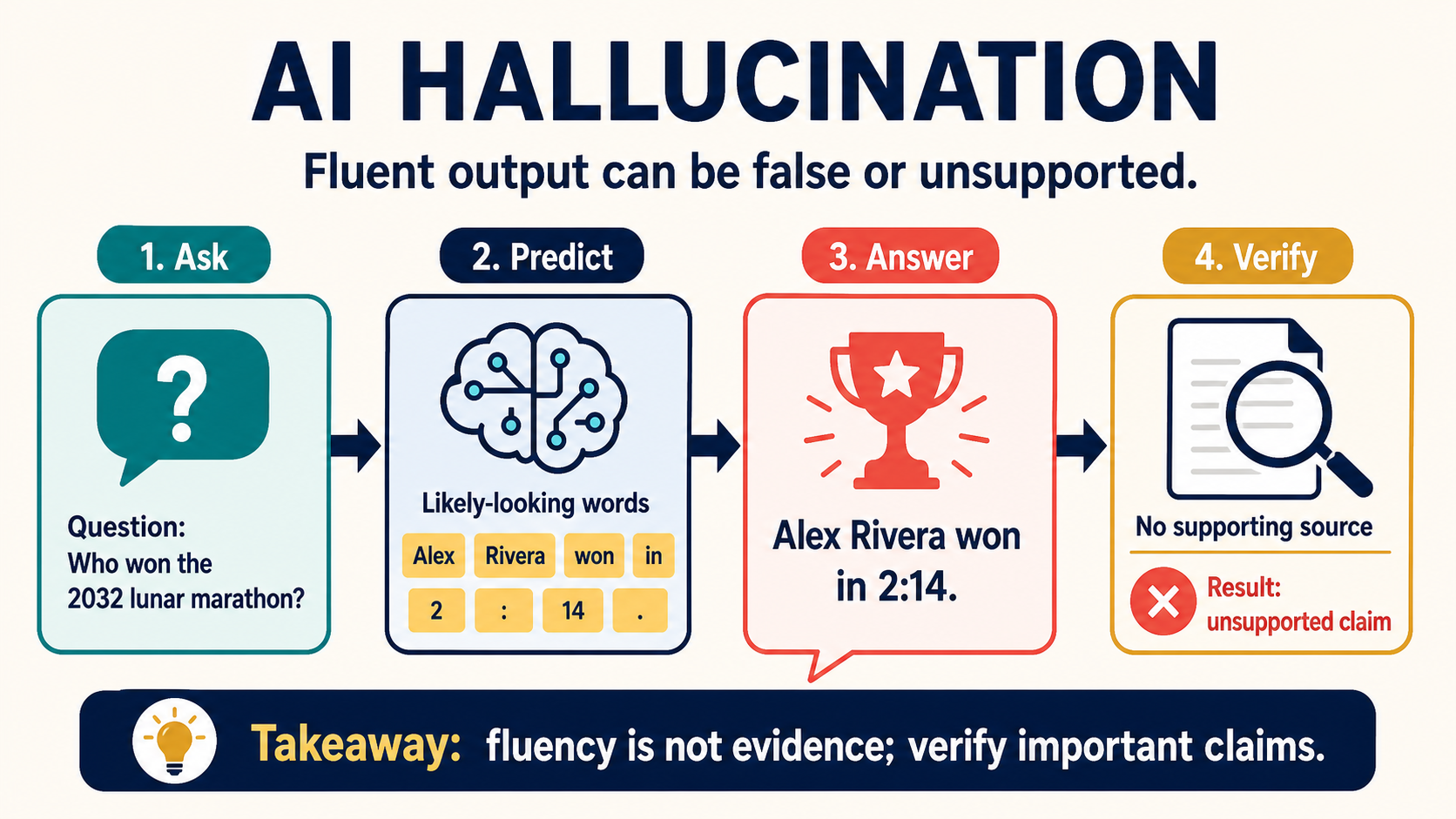
Foundations
AI Hallucination: Fluent but Unsupported Output
An AI hallucination, also called a confabulation, is generated content that is false, unsupported, internally inconsistent, or inconsistent with the provided input while often sounding plausible.
#AI safety#evaluation#reliabilityRead entry